
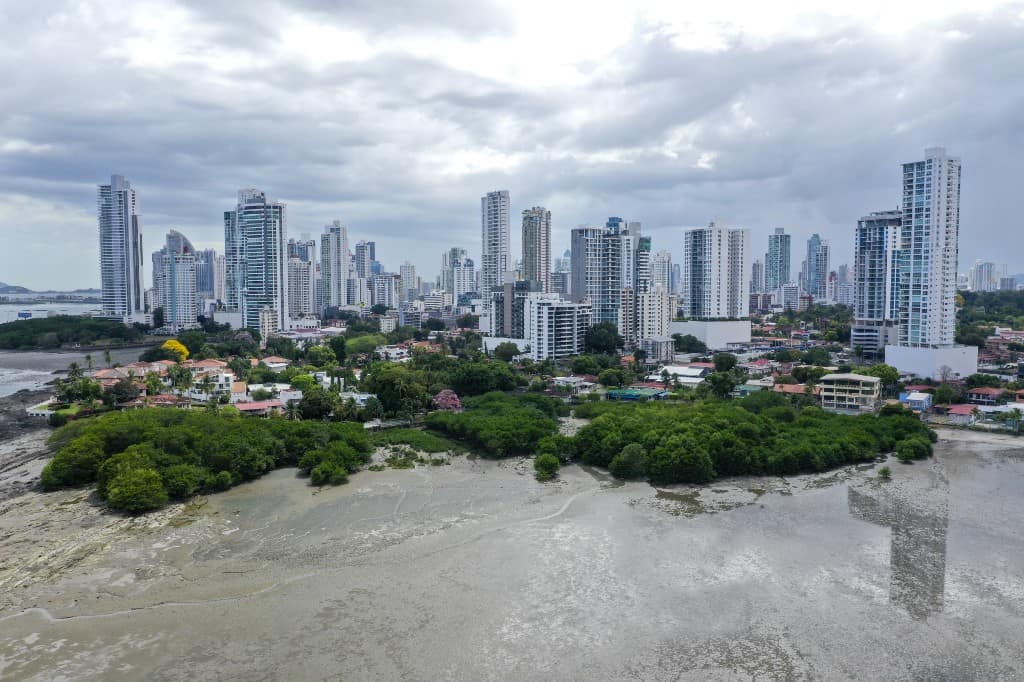
With vegetation almost impenetrable to the sun’s rays and food in abundance, Panama’s mangrove swamps are a vital resting place for thousands of birds on their migratory route. But pollution and urban growth threaten their “resort”
In the Juan Díaz mangrove swamp, a few kilometers from the center of Panama City, on the Pacific coast, the heat and humidity are palpable. The dry leaves, fallen from the trees, paint the ground ocher.
Located in the Bay of Panama, which is part of the Ramsar Convention on Wetlands, this habitat is considered one of the most important bird migration sites in the western hemisphere.
It is estimated that up to two million shorebirds alone pass through this area every year. In addition, according to Ramsar, the site provides habitat for up to 20% of the world’s population of the Semipalmated Plover and 14% of the Western Sandpiper. There are also parrots, iguanas, crabs, shrimp and shells.
“Panama’s mangroves, particularly those in the Bay of Panama, are of great importance for migratory birds in general,” Rosabel Miró, executive director of the ecological Panama Audubon Society, tells AFP. “They make a stop here, a strategic stop, which is basically to feed and gain that energy they need to continue the journey (…) It’s a resort,” she adds.
However, the birds coexist in the mangrove next to empty cans, plastic bottles, tire debris and shoe soles, which have been washed into the forest by the tide. “One of the most visible threats is plastic pollution, there are others that are not so visible such as the contamination of water sources by any type of water that we throw away in our homes that come with oils, chemicals from detergents,” which reach the sea and affect them, says Miró.
“Another threat is very much related to our lifestyle, we want to live near the coasts, but at the cost of the destruction of the mangroves, we destroy them, we fill them, we build our houses or businesses and all this to the detriment of these forests that somehow serve us as protection,” he adds.
Everything reaches the sea
According to Panama’s Ministry of the Environment, the country, with coasts on the Pacific and Atlantic, has the greatest variety of mangrove on the continent, with 12 of the 75 pure species of this shrub that exist in the world.
More than a hundred species of birds pass through the Juan Díaz every year. Some come from the Arctic, Alaska, Canada, the Amazon forests or the coasts of Chile and Argentina. They look for food and shelter while migrating from North America to South America, in October and November, and vice versa in the boreal summer.
Data from the Ministry of Environment indicate that Panama has more than 165,000 hectares of mangrove, less than half of what it was 50 years ago. However, in some places its coverage has increased due to different natural processes.
The main threats are livestock and agricultural activity and the construction of pharaonic infrastructure works for commercial and real estate use.
“Everything that is dragged by the rivers also reaches the sea and everything that reaches the sea by the tides reaches the mangrove,” warns Natalia Tejedor, a researcher at the Technological University of Panama.
Carbon sink
Mangroves protect the coasts from the ravages of the climate and feed many commercially important marine species. They are also major carbon sinks, which mitigate the emission of greenhouse gases. At Juan Díaz, a 30-meter tower measures solar radiation, carbon capture and humidity. According to Tejedor, these measurements will make it possible to know more precisely the contribution of these mangroves to the environment.
“How can we tell decision-makers to protect mangroves? Because of the benefits they provide. Among them, carbon sequestration. And now, with the Paris agreements [to combat climate change], it is a very important issue in which all countries are involved,” Tejedor says.
Authorities say Panama is one of the few carbon-negative countries, that is, it absorbs more greenhouse gases than it produces. Mangroves “are the first barrier we find between the mainland and the sea, they are fundamental, they are simply the first forest that protects us,” says Juliana Chavarría, a technician in the Blue Carbon mangrove study project.
In the Juan Díaz mangrove swamp you can hear the birds singing. In the distance you can see the skyscrapers of Panama City. Specialists bet on a healthy coexistence between environment and development. “Panama means abundance of fish. Abundance of fish equals abundance of mangroves. To the extent that we protect this type of ecosystem we will ensure our food and our marine-coastal resources,” warns Chavarría.