

GUATEMALA CITY — A groundbreaking sexual slavery trial that began in Guatemala on Feb. 1 seeks to expose the systematic rape of indigenous women that prosecutors say has been used by landowners and the armed forces for over a century to subdue native communities.
The women were allegedly abducted and enslaved in 1982 under the dictatorship of Efraín Ríos Montt (1982-1983), at the height of the country’s 36-year civil war that pitted the Guatemalan army against leftist revolutionaries. The war, in which more than 200,000 people were killed or forcibly disappeared — mostly by state security forces and paramilitaries — ended with peace accords in 1996.
The case is thought to be the first time ever, anywhere, that a national court is hearing charges of sexual slavery committed during an armed conflict. Prosecutors hope to gain reparations for the 11 women, set a precedent for prosecuting similar cases and raise awareness about the systemic nature of violence against women in Guatemala.
Petrona Choc Cuc, 75, testified at the trial on Feb. 3 in her native Q’eqchi’ through an interpreter. “They [the soldiers] told us to go take a shower. Then a fat man came, he was the first one to rape us, then other smaller men came and raped us,” she said. “Many times I was raped. One of my daughters was raped, too. … Every day I suffer because of what they did to me.”
Choc Cuc is one of 11 Mayan women from the tiny hamlet of Sepur Zarco, in the department of Izabal in eastern Guatemala, to describe during the ongoing trial how their homes were raided by soldiers from a nearby military outpost and how they were then enslaved, systematically raped and forced to cook and clean for their captors.
Over 30 years after their alleged ordeal, the women have come face to face with two men accused of ordering their enslavement: former base commander Esteelmer Reyes Girón, 59, and former regional military commissioner Heriberto Valdez Asij, 74.
Reyes and Valdez are accused of ordering and allowing the rapes. They’re also accused of enslavement, forced disappearance and murder of non-combatants — crimes considered “against humanity” and therefore exempt from Guatemala’s 1996 amnesty law. The law prohibits prosecution for political crimes committed during the war but does not include genocide and crimes against humanity.
Another woman who testified said that at the time of her ordeal she searched for Reyes and begged him to put an end to the repeated rape she was suffering by soldiers. She said he did nothing to stop his subordinates and told her, “Maybe you want it and they got used to doing it.”
On Feb. 16, Carmen Xol testified that she was taken by soldiers to the Sepur Zarco military base after her husband was abducted and disappeared. She said she was repeatedly raped and that soldiers injected her with contraceptives so that she wouldn’t get pregnant. She also said that she and others who were abducted were forced to take part in evangelical church activities every Sunday.
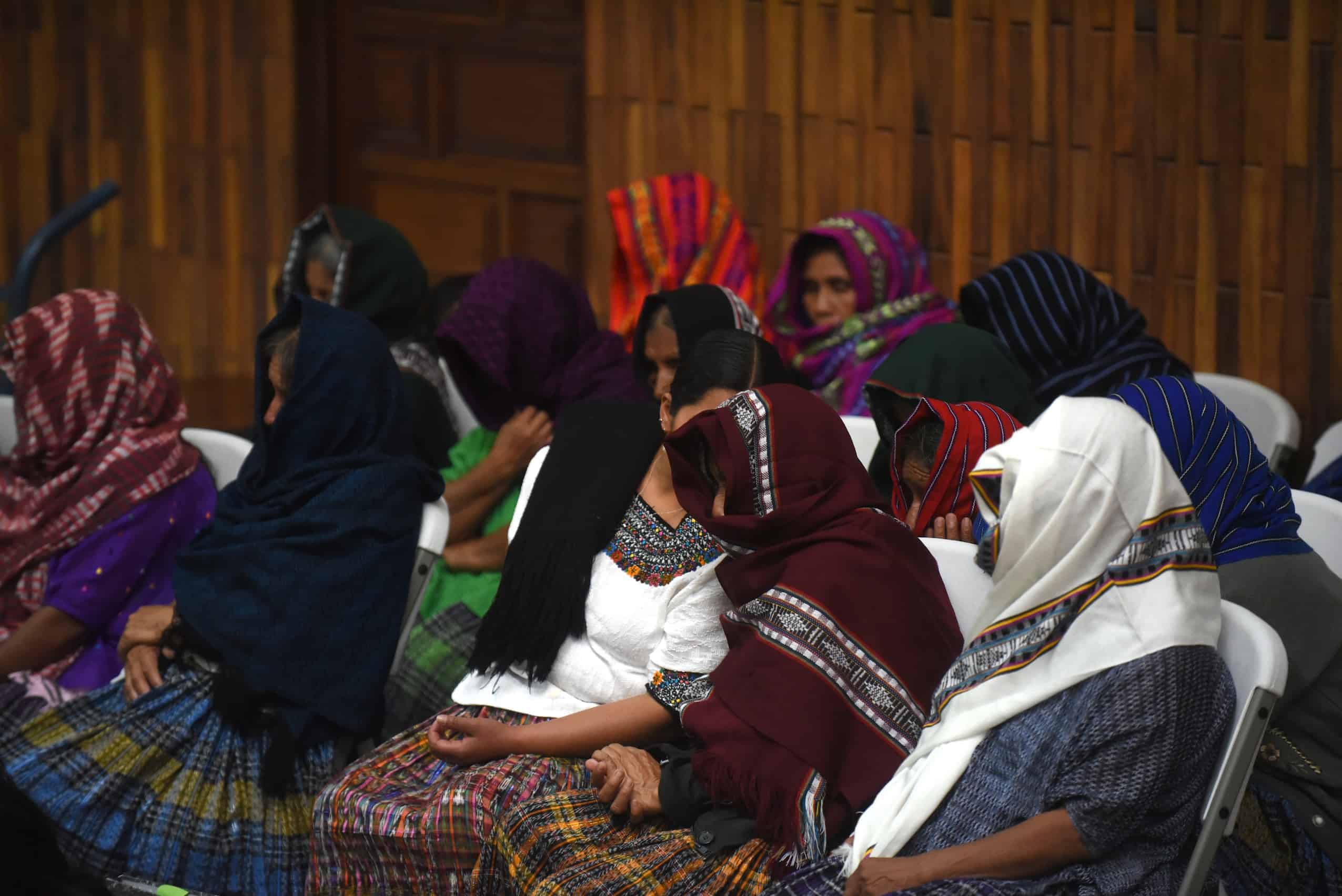
The women of Sepur Zarco appeared in court with their heads covered in shawls to hide their faces and only removed them to testify. Rape victims in rural Guatemalan communities are often shunned and ostracized.
Many observers from women’s and human rights organizations attending the trial have also covered their heads in a show of solidarity. Empathy, however, doesn’t appear widespread, and this trial, like others related to wartime violations, has divided Guatemalan society between supporters of the armed forces and its actions during the armed conflict and those who demand justice for the victims.
An Internet user who identified himself as “Barto Lomeo” wrote, “Find a job, lazy women!! Instead of trying to mooch off the state!” on the Facebook page of the Breaking the Silence Alliance, a collective of human rights organizations acting as a joint plaintiff in the proceedings.
A history of sexual violence
On Feb. 9, the prosecution presented 38 boxes containing the remains of 51 people killed at the military bases in Sepur Zarco and nearby Tinajas. Forensic experts explained that the remains are so deteriorated that only two of the 51 victims — including the husband of one of the women allegedly subjected to sexual violence — have been identified.
The prosecution also explained that Sepur Zarco, where most of the rapes occurred, was primarily used during the war as a “recreation area” for soldiers.
According to the U.N.-sponsored Historical Clarification Commission (CEH), which chronicled human rights abuses during the war, rape was selectively used by the armed forces against women belonging to guerrilla organizations up until 1979.
By the 1980s, the commission found, the army was using rape systematically against indigenous civilian populations.
The CEH recorded 1,465 cases of rape committed during Guatemala’s armed conflict. Eighty percent of the victims were indigenous. According to prosecutor Hilda Pineda, sexual violence was used as “a weapon of war” against the civilian population.
Witnesses for the prosecution have also testified that acts of sexual violence, such as those committed in Sepur Zarco, have been used for several hundred years as part of a strategy to subdue indigenous communities involved in land disputes with non-indigenous landowners.
During the second week of the trial, Juan Carlos Peláez Villalobos, an expert on land conflicts, explained that archival evidence shows that the Polochic Valley, where Sepur Zarco is located, has a long history of land conflicts. The territory originally belonged to the Maya Q’eqchi’ community, but outsiders encroached upon the land over the years, taking much of it over through violent means or fraud.
In an attempt to put an end to the land grabs, Maya Q’eqchi’ leaders tried to obtain legal titles to their lands in the early 1980s.
Peláez’s testimony ties in with the accounts provided by several witnesses who told the court that the men who were disappeared and killed by the army in 1982 were community leaders who were seeking titled deeds for community lands — actions that prosecutors allege prompted a backlash from the landowners, who called in the military to suppress indigenous organization in the area.
The acts of sexual violence perpetrated against indigenous women in this context, Peláez said, were part of a process of land dispossession used since the Spanish colonized the area.
“Indigenous people and the peasants were not considered to be human beings; they were viewed exclusively as bodies to work the fields,” he said. He added that the women were “completely subordinated to the will of the landowner” and that landowners traditionally used the motto “in the fields, in the kitchen, in the bed” to describe the worth of native women.
Decades later, the Polochic Valley continues to be a hotbed of agrarian conflict. In March 2011, 769 peasant families were forcibly evicted from land belonging to the Widmann clan — one of the most powerful land-owning families in the country.
Sexual violence today
Mayra Alarcón, a regional representative for Project Counselling Service, one of the organizations supporting the 11 women, said the prosecution’s historical examination of rape in Guatemala — beyond the actual crimes being tried in court — is strategic.
“We don’t just want the perpetrators to be sentenced; We want to show that sexual violence was an institutionalized crime that was far more complex than the act of rape. Sexual slavery was part of a systematic practice and women’s bodies were caught up in the fight for territory,” Alarcón said.
The ultimate goal of this “strategic litigation” strategy, used by the prosecution in a number of cases related to wartime human rights violations, is to correct injustices deeply ingrained in Guatemalan society such as racism and sexual violence. “We want a sentence with reparations, [but] not just for the victims. We want to draw attention to these issues so that new investigations can be opened beyond the sentence imposed on these two individuals,” Alarcón said.
Today, Guatemala has the fourth highest femicide rate in the world, with one woman killed every 12 hours, according to the U.N. Development Program. According to Paloma Soria Montañés, a gender expert who consults on cases before the International Criminal Court, there’s a clear link between the sexual violence that occurred during Guatemala’s armed conflict and the violence suffered by Guatemalan women today.
“This trial opens a window of opportunity to highlight that and send out a message of zero tolerance towards violence against women,” she said.
The two men accused in the case could receive prison sentences of up to 30 years. A verdict in the case is expected by late February.





