

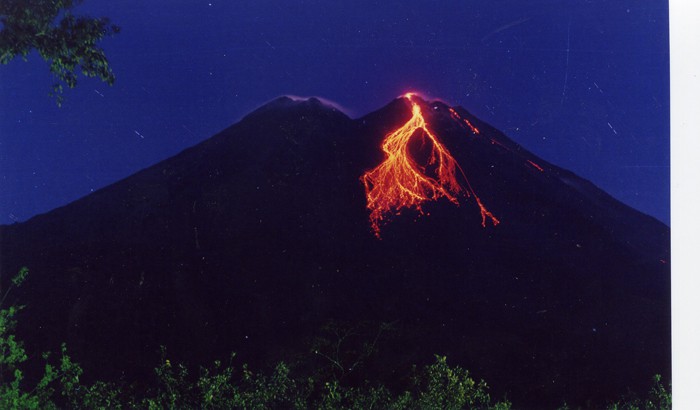
Nestled at the base of one of the world’s most active volcanoes, in the north-central region of Costa Rica, lies the aptly named town of La Fortuna –“fortune” or “luck,” in English. Arenal Volcano’s violent July 1968 eruption destroyed three small villages, killed 87 people and wiped out 232 square kilometers of crops and livestock, but La Fortuna was spared. Since then, its 8,000 residents have made their peace with the consistently active volcano to form a delicate harmony.
Each year, Arenal Volcano National Park receives approximately 60,000 visitors, and infrastructure in the area is increasing to support the constant flow of tourists. Most La Fortuna residents have become accustomed to the frequent rumblings of Arenal Volcano and have begun to recognize their dependence on the booming tourism industry drawn by its regular, awe-inspiring activity. The volcano has become the star attraction in a long list of tourist activities La Fortuna has to offer, including hot springs, horseback riding and adventure tours ranging from zipline canopy tours to white-water rafting.
Not Scared
Since the tragic deaths of an 8-year-old U.S. tourist and a Costa Rican tour guide after an August 2000 eruption (TT, Aug. 25, 2000), and the resulting risk-area zoning established around Arenal Volcano by the National Emergencies Commission (TT, Feb. 23, 2001), tour operators have settled into a respectful coexistence with the volcano.
Local tour manager Vanessa Willing of Wave Expeditions said she has lived in La Fortuna for two years and is not overly concerned about living in the shadow of Arenal. “I’m not really scared,” she said. “No one has completely forgotten about the volcano. They can’t; it’s a part of all our lives, and most of our work depends on the tourism received from it.”
She said as long as it stays slowly active, no one is concerned. “When it goes quiet, that’s when I’ll worry,” she said. La Fortuna Hotel owner José Soro said the town almost entirely revolves around tourism. “Ninety percent of La Fortuna depends on the tourism industry; the rest is agriculture and dairy farms,” he said.“Most of that 90% are local business owners, which means the money we produce stays in the region. This is very important for us and the country.”
Soro doesn’t feel concerned about living next to the volcano; on the contrary, he is excited about the energy it brings to the town. “I feel completely comfortable and have great expectations for La Fortuna,” he said. Besides adventure tourism, one very successful area of business has been the development of hot springs. Using rainwater and water heated by the magma of the volcano, hot springs resorts such as Tabacón and Baldi have become trademarks of the Arenal experience.
Tabacón Grand Spa Thermal Resort opened in 1993 and is considered the most luxurious, and expensive. Since then it has flourished as a resort, with the tourism industry pushing it to renovate and expand over the past few years to include 114 guest rooms. The resort was recently awarded fivestar status from the Costa Rican Tourism Institute (ICT).
Active Volcano
Protected within a national park of the same name, Arenal Volcano erupts approximately every 10 minutes, according to park guide Oscar Artanla. With a permanent seismic station constantly measuring tremors and eruptions, residents such as Artanla are confident that another eruption would not be as devastating as the one in 1968.
“The volcano is constantly monitored; that information gets beamed back to stations in Florida (in the United States), where they have experts looking at the material and statistics,” Artanla said. “I think La Fortuna is safe because it’s on the east side of the volcano,” he added. “I do think we have to respect the volcano and take responsibility to make sure all the visitors are safe on the tours in Arenal.”
Despite confidence that a serious eruption remains unlikely, opinions vary on whether or not the town is prepared. Area resident Warner Baltodano said the city recently executed an evacuation drill and that he was comfortable with the way the test evacuations were carried out.
“They got everyone out of the town in a test run about four months ago. That worked well,” he said. However, other residents feel an eruption could take residents off guard. Willing said she was not so confident in evacuation plans. She was not informed of the practice evacuation and was not aware of many emergency plans.
“I think if it’s going to blow, then we wouldn’t have much warning,” she said.
Arenal Area Resident Recalls 1968 Eruption
In 1968, Jorge Eduardo Solórzano lived six kilometers from north-central Costa Rica’s Arenal Volcano, near the town of La Fortuna, then a basic village that supplied necessities to area farmers and cattle ranchers. The 10-year-old boy attended fifth grade at the school in La Fortuna.
“I had to walk a few kilometers every day to get to school, on a dirt road that formed part of the forest, which scared me because wild animals and snakes often crossed there,” recalled Solórzano, now 49. Back then, the looming figure of Arenal Volcano was just another mountain, called Cerro Arenal, dormant for more than 400 years and thought to be extinct.
According to area residents, some people even slept in the crater; the fertile land surrounding it was an ideal place to grow crops, and the crater offered farmers protection from the elements at night. Two days before the fateful eruption, residents say, strange warning signs became evident. The temperature of the water in the river rose, and minor earthquakes began to shake the town.
Solórzano recalls that he and his family were terrified of the earthquakes on that Sunday evening. “The rumbling noises sounded like airplanes taking off,” he said.“But we thought it had to do with the severe storms that were common around that time of year.”
Villagers living near the volcano did not realize the danger of these signs until it was far too late.
On the morning of Monday, July 29, 1968, Solórzano arrived at school, only to be sent home by an informed teacher who announced that Cerro Arenal had become a volcano. Safe on their distant property, Solórzano and his family watched the volcano explode. “Nothing could be seen between the colossal roars that sent ash columns tumbling down; it seemed like a giant, black cauliflower and the tremors did not stop,” he recalled.
According to Arenal park guides, 87 people were killed that day in settlements closer to the volcano, but La Fortuna was spared. Solórzano and his family retreated to the Central Valley coffee town of Palmares, northwest of San José, for a month before returning to their property. The eruption marked a huge change in the lives of all area residents, Solórzano said.
“Everyone immediately wanted to know what had happened and why; we were all uncertain,” he recalled. “But as time passed, little by little people began to return to the volcano.” Now Solórzano agrees that Arenal Volcano has become a huge tourist attraction that the people of La Fortuna have learned to use to their advantage.
“I am a commercial retailer and have devoted my life to tourism,” he said.





