

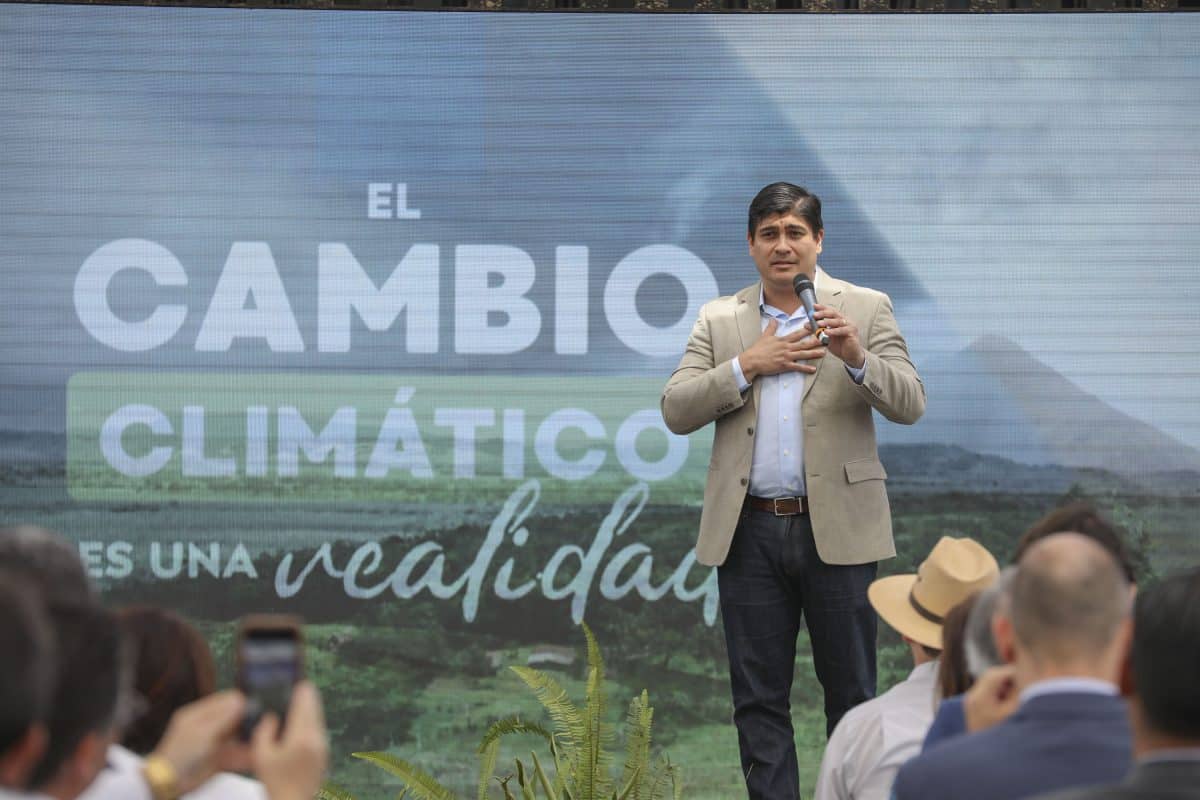
On Sunday, Costa Rica announced its vision for the future, and it’s carbon-free.
Christiana Figueres, who’s heading the United Nations fight on climate change, took to the stage at the Museum of Costa Rican Art to introduce the plan.
She noted that the museum used to be Costa Rica’s international airport, connecting it with the world. The small country soon outgrew it, and needed to think bigger. That, she said, is exactly what the government is now doing again: Thinking big and moving past its comfort zone to decarbonize its economy by 2050.
A number of speakers — some in person, some by teleconference— such as President Carlos Alvarado, former U.S. Vice President Al Gore, the Prime Minister of Spain and heads of several Costa Rican ministries took to the stage to praise Costa Rica’s initiative. There were also performers dressed as a number of different animals crawling and flapping around the diplomats and politicians.
But it was First Lady Claudia Dobles and Minister of the Environment and Energy Carlos Manuel Rodríguez who presented concrete plans to move forward.
Dobles presented a new transportation system, focused on walking, biking and an electric train. The train would serve as the spinal cord of the city’s transportation system and everything would connect to it. By 2050, they want it to run solely on electricity.
Rodríguez presented a 10-point plan that included transportation, waste, cattle, agriculture, construction and cargo. The plan is divided into short-term goals that would be completed by the end of this administration in 2022, and longterm goals that range from 2030 to 2050.
A lot of the short term goals involve completing studies or pilot programs, but there were some ambitious concrete goals. The government is hoping to have an electric cargo rain operational in Limon (TELCA). They want to install 69 fast charge stations for cars and have electric busses operating on public routes.
The plan is ambitious, but it’s also expensive.
Despite passing a hard-fought fiscal reform in the second half of 2018, the country’s debt remains high and so do financing costs. The government expects outside financing from green funds, the International Development Bank and private investors; but it will still have to cover a large share of the cost.
An International Monetary Fund statement released Monday says the fiscal reform largely addressed spending, but the country needs more revenue. It suggested increasing the VAT from 13 to 15 percent, increasing property taxes, profits on cooperatives and increasing excise taxes on certain goods and services.
And this is without factoring in the cost of the government’s decarbonization effort.
This story was made possible thanks to The Tico Times 5 % Club. If only 5 percent our readers donated at least $2 a month, we’d have our operating costs covered and could focus on bringing you more original reporting from around Costa Rica. We work hard to keep our reporting independent and groundbreaking, but we can only do it with your help. Join The Tico Times 5% Club and help make stories like this one possible.





