
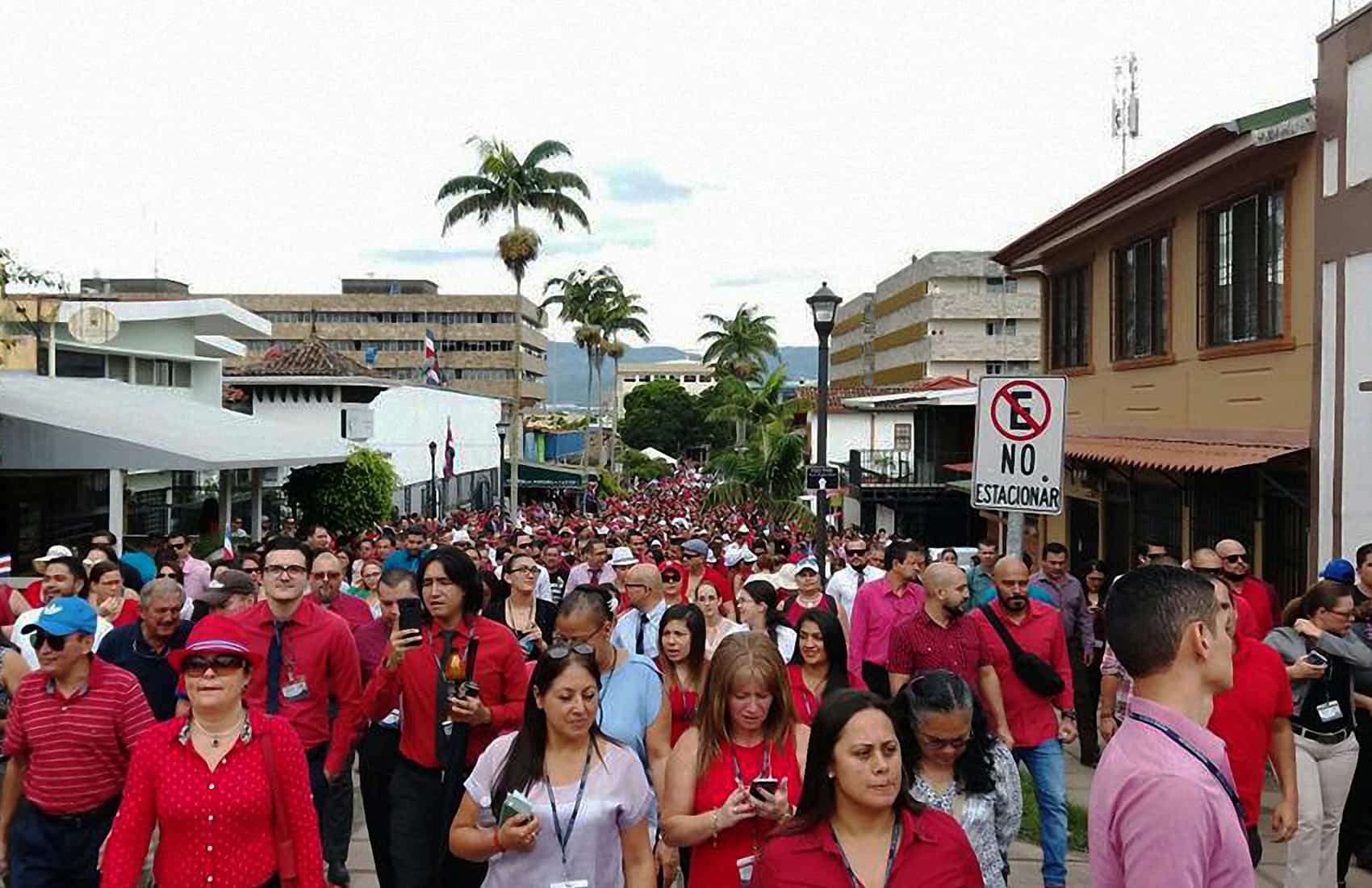
Leaders of Costa Rican Judicial Branch workers’ unions, on strike since last week over a stalled pension reform plan, announced Monday that other public-sector unions will join them in a national protest on Wednesday.
The strike by some 13,000 judicial employees in all seven provinces has led to the suspension of trials, investigations, processing of criminal complaints, and even administrative procedures such as issuing criminal background checks that people need for job applications.
One of the main consequences, however, is that the coroner’s office stopped performing autopsies, and bodies began to stack up at the morgue.
On Sunday, the Constitutional Chamber of the Supreme Court, or Sala IV, ordered the coroner’s office to resume autopsies immediately. Judicial Police Director Walter Espinoza Espinoza confirmed on Monday that all forensic experts refused to comply and remain on strike.
Espinoza said that, as of Monday noon, there are 35 bodies that authorities have not been able to release due to the lack of an autopsy.
At a public event in Guanacaste, President Luis Guillermo Solís said that he knows the whole country is outraged by the situation and asked union leaders to show mercy for the relatives of those at the morgue.
Later on Monday he said he had asked Social Security System officials to assess options for assisting the Judicial Investigation Police with pending autopsies.
https://www.facebook.com/luisguillermosolisr/videos/vb.199246583438202/1764503620245816
At around 11:20 p.m., National Police Director Juan José Andrade tweeted that officers had taken control of the morgue, and that they were allowing a group of forensic doctors to enter the facilities and begin working on the autopsies.
Andrade said they were complying with a request from Supreme Court Justice Celso Gamboa. However, he did not disclose details about whether the doctors were from the coroner’s office or from public hospitals.
@fuerzapublicaCR Tomando control del Complejo de Ciencias Forenses, ante solicitud del magistrado @CelsoGamboaCR #HacemosNuestroTrabajo pic.twitter.com/jaFVmBvgn8
— Juan Jose Andrade M. (@j_j_andrade) July 25, 2017
Controversial pension reform
The strike began on July 19 when union leaders called for a strike after the Legislative Assembly tabled a proposal the unions had drafted to reform the Judicial pension system.
A legislative committee is now evaluating other options to reform the pension system, which, according to an actuarial study by experts of the University of Costa Rica (UCR) and the Pensions Superintendency (SUPEN), is at risk.
UCR researchers recommended that the pension system be adjusted immediately as “current income is no longer sufficient to pay for expenses, and the deficit will only increase over the next years.”
The study estimated that, if no changes are made, the pension fund will begin to have problems paying its retired workers by 2029, and will be completely depleted by 2048.
The unions’ plan essentially proposed to cap monthly pensions at ₡4.7 million (some $8,215) and raise the retirement age to 65.
At present, judicial workers can retire as early as 55, while all other workers must work until they are 62. In addition, they receive a pension equal to 100 percent of their last salaries, while other workers receive a maximum of 62.5 percent.
Most retired workers currently receive maximum pensions of up to ₡1.5 million (about $2,600), while pensions for judicial workers do not have a cap. Some retired workers are receiving monthly pensions of up to ₡9 million ($15,700).
Lawmakers dismissed the unions’ plan and are now drafting a new one using UCR and SUPEN’s recommendations. The new proposal seeks to increase the pension age and cap monthly pensions.
Among other emergency actions, experts recommended raising the retirement age to 65; increasing workers’ monthly salary deduction for pensions from 11 to 15 percent; and capping the highest pensions at ₡4 million ($7,000).
Legal actions
On Monday, the Prosecutor’s Office ordered the opening of an investigation of the forensic doctors and coroners’ office employees who refused to comply with Sala IV’s order to resume autopsies.
Chief Prosecutor Jorge Chavarría said at a press conference that authorities are trying to resolve the backlog of autopsies.
“We’re trying our best to avoid further suffering for all the families who haven’t been able to have a funeral,” he said.
He said that they were evaluating options such as performing some of the autopsies at public hospitals and temporarily hiring forensic doctors.