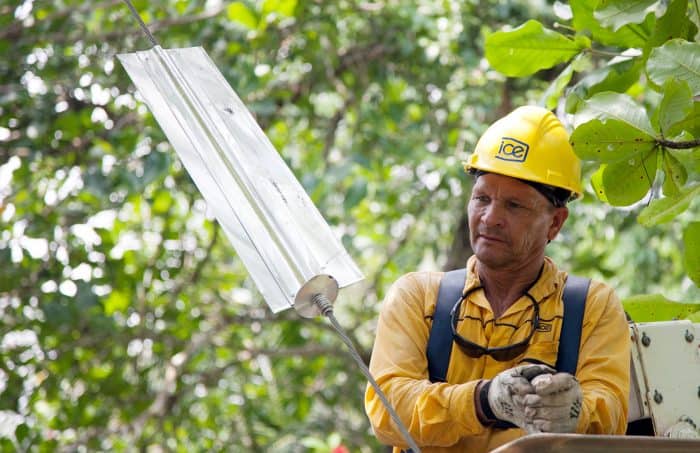
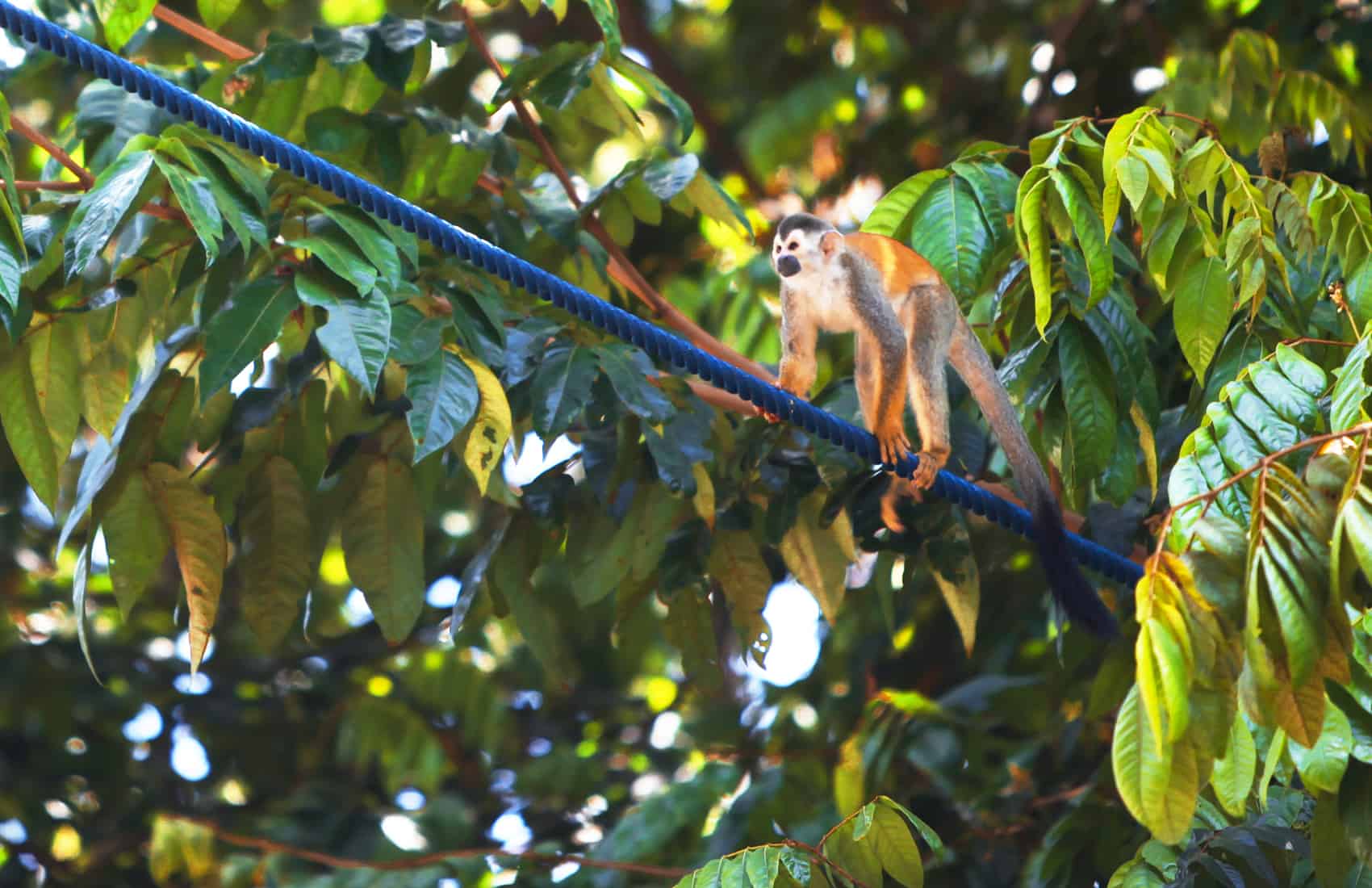
The Costa Rican Electricity Institute (ICE) reported that in the past two years it has spent ₡250 million ($460,000) on measures to protect wildlife, particularly to prevent animals from dying while using power lines to cross between trees.
ICE’s report, issued Friday, notes that the state-run utilities company has installed 20,425 devices in the past 24 months to prevent birds and arboreal mammals from touching power lines along 248 kilometers of roads in the central, southern and central Pacific regions of Costa Rica.
ICE employees trimmed branches along the roads to separate the trees from power lines, and then placed hanging ropes.
Earlier this month a group of at least six squirrel monkeys were electrocuted near Quepos, along the Pacific coast. Environment Ministry officials at the time reported that the monkeys likely jumped onto power lines from a branch because there are not enough trees in the area to cross over the road. ICE officials said a lack of trees is the main problem for placing hanging ropes in certain areas.
Workers also installed 10,000 anti-climbing devices on utility poles and stabilizing wires to prevent arboreal mammals from crawling up the poles after they descend from trees.
ICE’s environmental manager Miguel Víquez said the measures particularly benefit the four species of monkeys that live in Costa Rica, in addition to sloths, kinkajous, opossums and other species that live in the upper layers of trees.
ICE also installed 56 cameras to monitor forest areas near power plants to study the interaction of wildlife with the new devices. That helped ICE rescue 38,893 animals at the Reventazón Hydroelectric Project alone. The animals were relocated to safer areas, ICE reported.
“Our essential mission to provide electricity will always be linked to the protection of our natural resources,” Víquez said.
In April, the Public Works and Transport Ministry also began installing new traffic signs urging motorists to slow down for animals on the road. The new signs are yellow and diamond-shaped with black silhouettes of a monkey, deer and coati crossing a road.
Research by the University of Costa Rica’s Ecotourism School last year found that speeding drivers are the main cause of wildlife deaths on roads in Costa Rica’s Pacific region.
Investigators for a full year traveled 650 kilometers to count the number of wild animals killed on the roads. Their research determined that most of the animals were mammals, accounting for 41.8 percent of the total, followed by reptiles at 23.5 percent, birds at 32.6 percent and amphibians at 1.31 percent.