

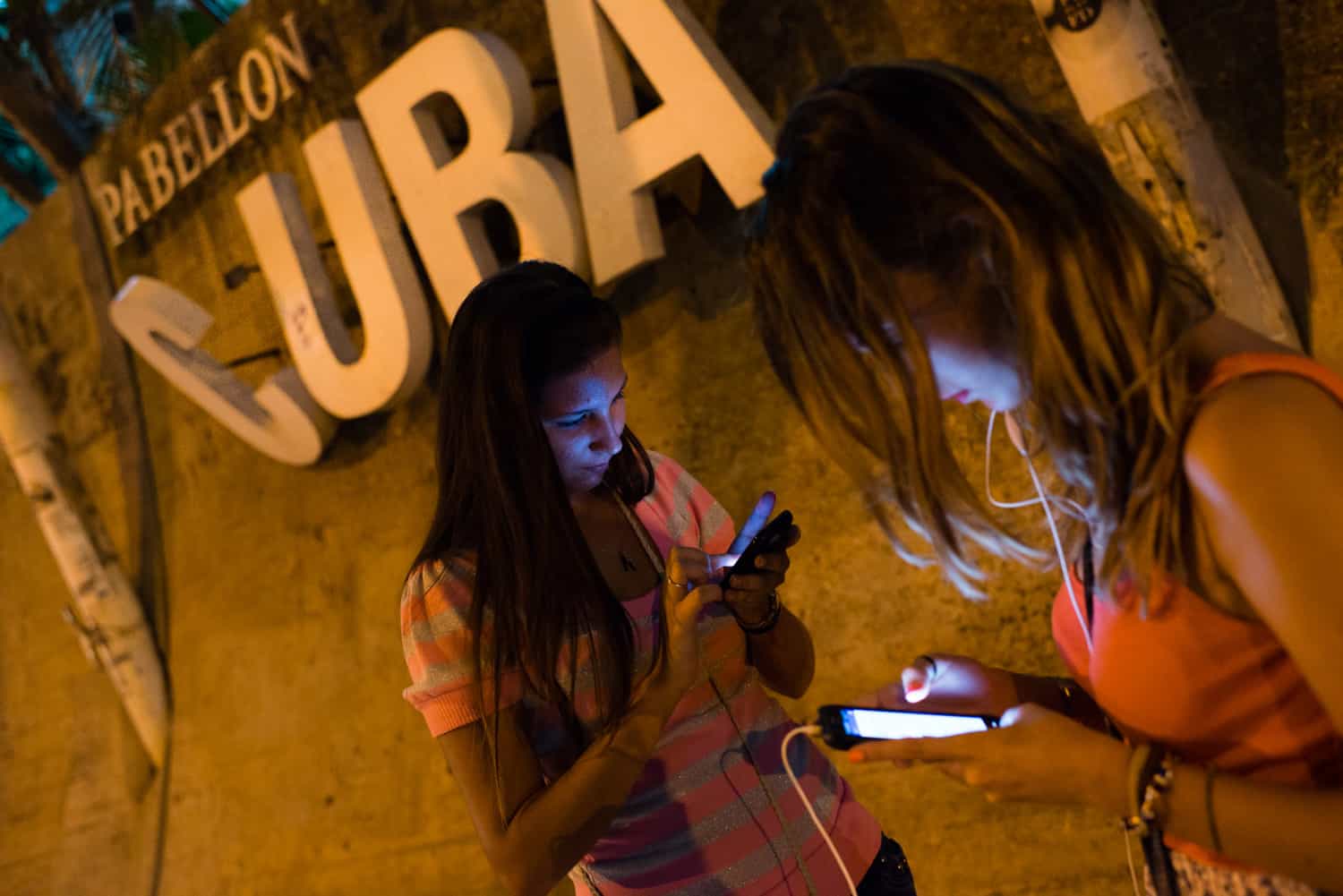
HAVANA, Cuba — The busy stretch of 23rd Street in Havana that slopes upward from the seawall is known as La Rampa (The Ramp). It’s a fitting name for the place where many Cubans are discovering the Internet for the first time.
Walk along La Rampa on a typical evening and the sidewalks are jammed with young Cubans, their faces lit up in the blue glow of laptops, tablets and phones. They’re on Facebook or chatting with loved ones and friends in Miami and beyond, shouting over the din of bus engines and old Russian Ladas groaning up the hill.
La Rampa is one of five places in Havana — and 35 in Cuba overall — where the least-connected country in the Americas suddenly has public WiFi. They’re like water-slide parks set down in the middle of a desert.
“Sensational,” said Bryan Matos, 20. “A dream come true.”
Expanding Internet access was one of the things the communist government agreed to as part of the negotiations to reestablish relations with the United States. But Cuba, of course, is doing it in its own particular way.
Instead of offering mobile data plans through the state telecom monopoly, or residential service, the government has wired up a series of large Chinese-made Huawei antennas at a handful of outdoor locations like La Rampa, turning sidewalks and parks into sprawling Web lounges.
When the WiFi works, that is. With hundreds of people trying to log on, day and night, La Rampa’s network and others are often maxed out.
The Cuban government says the only obstacles to improved Internet access are technical and financial, not political or ideological. It has set a goal of 50 percent household penetration by 2020. But it has also said it will prioritize “social” Internet use, at schools, hospitals and other public institutions.
Social use on La Rampa is like a bigger, grimier version of Starbucks, without the coffee or the bathrooms. Cubans surf from the sidewalk late into the night, and during the day they crowd into patches of shade to escape the withering tropical sun. Water drips down from air conditioners jutting out of office buildings and apartments above.
Despite the lack of amenities, no one was complaining the other evening that they couldn’t have high-speed Internet at home. Several young Cubans said they liked the festive atmosphere.
“I think we’re used to doing things as a group,” said Sergio Garcia, a 21-year-old university student who uses his WiFi time to stream trailers for Hollywood movies, such as “Avengers: Age of Ultron,” on his phone.
“If we had Internet at home we’d probably be even lazier about getting out of the house,” he said.
This being Cuba, it also took black-market entrepreneurs about two minutes to figure out a way to turn the government’s WiFi service into a nifty business opportunity.
The $2 scratch-off cards that the state telecom monopoly sells for an hour of prepaid WiFi service are bought up and hoarded by “re-sellers” who walk up and down La Rampa selling them for $3 apiece. “Cards, cards,” they mutter in hushed tones, like drug pushers.
More tech-savvy Cubans have figured out a way to set up their own parallel WiFi networks on La Rampa using apps like Connectify that allow a single prepaid card or account to be shared among several users. They offer Web access for $1 an hour by converting their laptops or mobile devices into mini-antennas that can log on several paying customers at a time, albeit at slower speeds.
Cubans who do this say the police don’t even bother trying to stop them, though re-sellers of WiFi cards risk arrest and fines. “They took me down to the station yesterday,” said one 24-year-old card vendor, who was back at work the next day, undeterred, after an $8 fine.
At the city’s other high-demand hotspots, Cubans have figured out how to jerry-rig charging stations by tapping into the electrical wires of the street lamps. Others bring their own folding chairs. Just as Havana residents use the city’s famous Malecón seawall as a huge open-air lounge for drinking and playing music, they are turning the hotspots into places to party and browse the Web.
Cuba ranks 125 out of 166 nations in telecommunications development, according to the United Nations. Only about 5 percent of Cuba’s 11 million citizens have regular Internet access, though that was before the 35 hotspots were enabled last month.
A large number of Cubans still connect via dial-up modems, over a phone line, like AOL subscribers circa 1997. Government ministries and businesses have broadband, and tourist hotels offer WiFi but it’s mostly restricted to guests.
ETECSA, the government telecom monopoly, has computer terminals in its offices for hourly Web use, but the WiFi hotspots are the first places that allow Cubans to freely get online with their own devices, and the enhanced sense of privacy and freedom that comes with it.
Some anti-Castro sites are blocked on government servers, but others are not, and for the most part, Cuban WiFi users have access to the global Internet. Though not as fast as U.S. broadband, there’s enough bandwidth to stream YouTube clips or baseball highlights. The government blocks Skype, so Cubans use a program called Imo for video chats with friends or family abroad.
“My daughter sent me this from Tampa,” said Marta Rodriguez, 52, standing on a street corner along La Rampa, trying to connect her brand-new Samsung tablet to the network. “I haven’t seen her in a year and a half.”
Rodriguez makes her living by renting out a room in her home to tourists. Both her children have left for the United States. She has never traveled off the island, she said, nor used WiFi before.
“In any other part of the world, it’s something totally normal, a part of civilization,” she said. “But for those of us who have lived our whole lives under the [Castro government], this is something we never thought we’d see.”
Rodriguez and two friends stood under the street lamps for at least an hour, but the network was too overloaded to let her log on. The video chat would have to wait. But her friend got lucky for a few minutes, long enough to look at photos of Rodriguez’s daughter’s apartment on Facebook, and send a message saying she’d try again the next day.
© 2015, The Washington Post





