

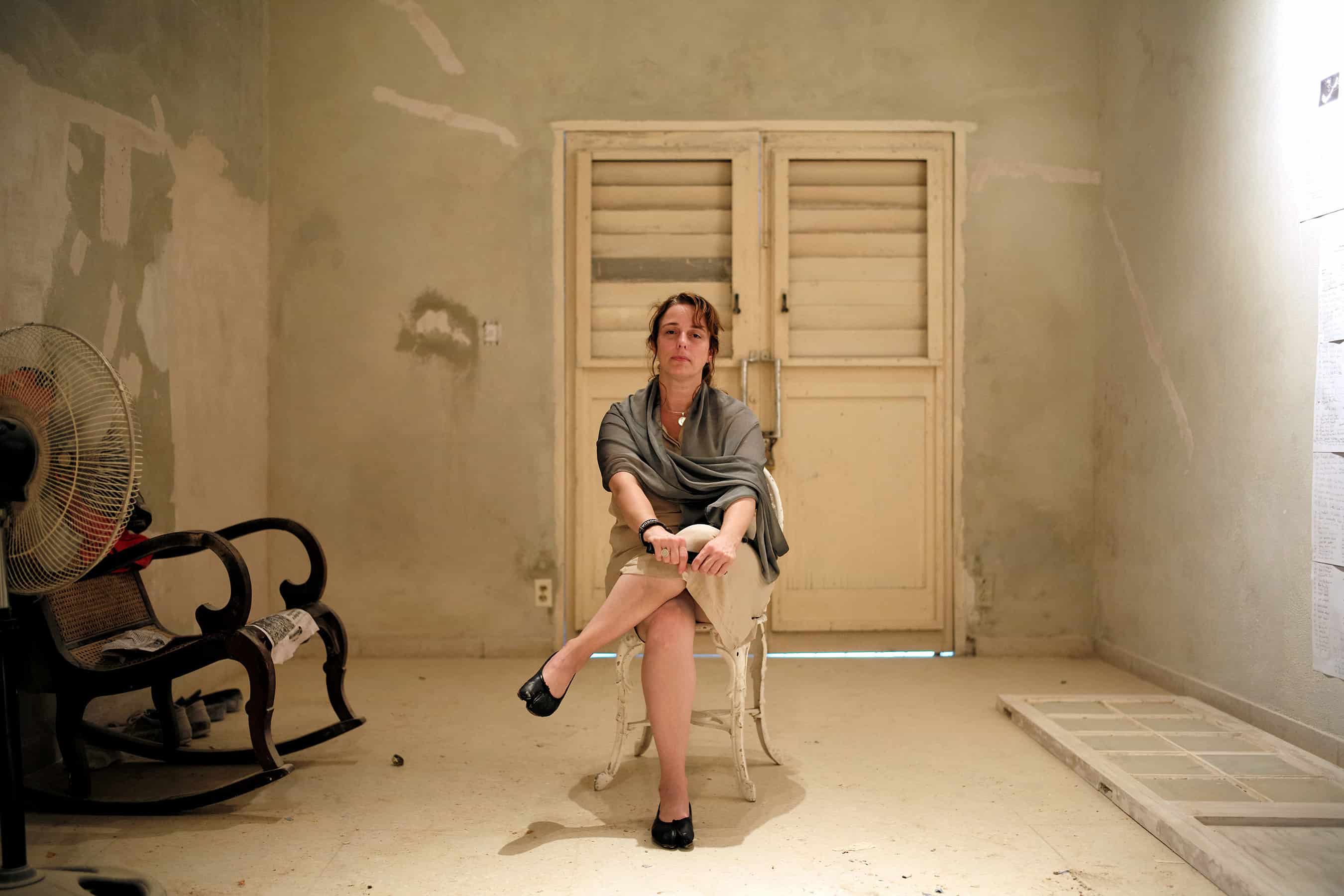
HAVANA, Cuba – It was probably inevitable, given the trajectory of her career, that Cuban artist Tania Bruguera’s creative vision would collide some day with her country’s less-expansive political reality.
From a young age, Bruguera, 46, won international acclaim as an irreverent, barrier-breaking performance artist. She smeared the floor with pig’s blood to make a point about sexual assault. She stripped naked and ate dirt in tribute to Cuba’s vanished indigenous tribes. During one performance in Colombia, she circulated trays of cocaine — real cocaine — among the audience, inviting viewers to try it. They did.
By comparison, what landed Bruguera in trouble with communist authorities seems rather mild. Soon after the Dec. 17 announcement that the United States and Cuba would restore diplomatic relations, Bruguera flew to the island from Europe and tried to organize a free-speech forum. The transgressive part was the location: Havana’s Plaza of the Revolution.
It was meant as a challenge, she said — a test to see how much Cuba was willing to change as part of its new relationship with the United States.
The event never happened. Before she could reach the plaza, Bruguera was arrested, along with more than two dozen supporters. Since then she has been detained four more times and has been barred from leaving the country while facing charges of disturbing the public order, resisting arrest and inciting criminal behavior.
Cuban authorities “are trying to depict me as a rebel without a cause,” Bruguera said in an interview, her arms still bruised after being hauled off by police with members of the Ladies in White opposition group after their weekly protest march.
“I am a rebel, but one with a cause, and it’s one that they have given me: the fight on behalf of freedom of expression and against political hatred,” she said.
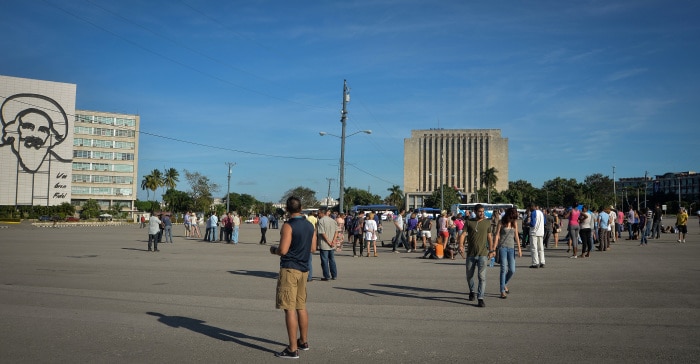
Cuban authorities do not see Bruguera as a causeless rebel so much as a calculated provocateur, backed by anti-Castro forces abroad, who is swooping in for a political stunt. Soon after she arrived in late December, Bruguera said, security officials took her aside to issue a warning about her plans for the open-mike event.
“They told me: ‘You think you’re coming back here to create another Maidan [the square in Kiev where Ukraine’s 2013-2014 revolution began], but we’re not going to let you.’ ”
Bruguera’s treatment also suggests that communist authorities intend to send a signal to other Cubans who are thinking of returning home to take advantage of new economic opportunities and easing tensions with the United States. Cuba is willing to welcome them back as entrepreneurs, sure, but not as dissident activists.
Bruguera, who has lived most of the past two decades in the United States and Europe, says she never emigrated from Cuba. In recent years, as she worked to organize an immigrant political party in Paris and joined the Occupy Wall Street movement in New York, her creative work increasingly smudged the line between art and activism.
The former — in particular the kind that takes place in museums and movie theaters — has considerable latitude in contemporary Cuba. The latter, when it occurs in the street, does not.
In 1961, two months after the Bay of Pigs invasion, Fidel Castro issued the famous dictum that would lay out his view of artistic freedom: “Within the Revolution, anything goes; against the Revolution, nothing.” Cuban artists have been trying to figure out what that means pretty much ever since.
The issue is not an academic one. Art is big business in Cuba, and one of the careers that allows young people to earn income independently, profiting from a global fascination with the island that is as strong as ever, particularly among collectors in the United States.
Over the years, as censorship eased, art also became an outlet for expression in a country that doesn’t allow traditional activism. Young Cubans who seethe at their government’s political controls or Internet restrictions can’t protest in the street, but they can produce dark, brooding works of art that dramatize or satirize Cuban reality. And international collectors love the stuff.
Bruguera, who earned a master’s degree at the School of the Art Institute of Chicago and went on to teaching positions in the United States and France, doesn’t make objects that look nice on a coffee table or complement the drapes. Her art, by nature, is intangible and somewhat unpredictable.
And because Bruguera wants to blur the line between art and political activism, it can also make it difficult to discern where her “performance” starts and ends.
Bruguera’s legal ordeal over the past six months serves a broader artistic goal, she says, in which the Cuban government has been an all-too-willing participant in her attempt to probe the boundaries of expression at what she sees as a pivotal moment in her country’s history.
“All of this is a performance,” she said. “It is unfolding as events occur.”
The government prefers theater, she said. “It likes having a script that can be acted out by a cast of characters it creates.”
In contrast, she said, “performance is a space for spontaneity, where human beings can be themselves, instead of acting out roles.”
Like Cuban authorities, critics of the Obama administration do not view Bruguera’s case as an abstract exercise in aesthetics. Her arrest is proof, they say, that Cuban President Raúl Castro isn’t opening up at all and that Obama’s policies have emboldened him to be more repressive.
“We’re not naive,” read a statement by the president of Cuba’s Fine Arts Association on the day of her arrest. “The meaning of this performance isn’t going to be interpreted as a work of art. It is a political provocation.” Her goal, the statement said, was the same as that pursued by Castro’s opponents, who, it added, helped promote her appearance.
“The act has no other aim than to undermine the negotiations that have given hope to many human beings, above all Cuba’s 11 million people,” the statement read.
Bruguera, who identifies herself as a leftist and calls Sen. Elizabeth Warren, D-Mass., her “favorite politician,” insists it is not her intention to embarrass the Obama administration or give fodder to its critics. She said her goals are wholly related to Cuba’s uncertain future. She wants a new law protecting freedom of speech and to open a center for art and activism named for the late political theorist Hannah Arendt.
Bruguera’s most recent arrests occurred in the middle of Cuba’s biggest art festival — the Havana Biennial — with many of the world’s leading gallery owners and collectors in town. Some supporters urged a boycott and gathered protest signatures on her behalf, but ripples from Bruguera’s case haven’t reached very far beyond Cuba’s arts scene.
Some artists and critics said they have been confused about her goals. They don’t want to see Bruguera treated as a criminal, but they said they are puzzled as to what the avant-garde artist was trying to accomplish.
“I never saw Tania as a political activist,” said Cristina Vives, an art curator and historian who worked with Bruguera earlier in her career and considers her “brilliant.”
“She didn’t need it to be effective as an artist,” Vives saod. “And she has always been one of the most effective artists I know of.”
Asked if she viewed her work as “against the Revolution” and beyond the boundaries vaguely established by Castro in 1961, Bruguera answered with a question.
“What is the Revolution today?” she asked. “I think the negotiations with the United States have created a crisis of identity and a need to redefine what ‘revolution’ means.”
© 2015, The Washington Post





