
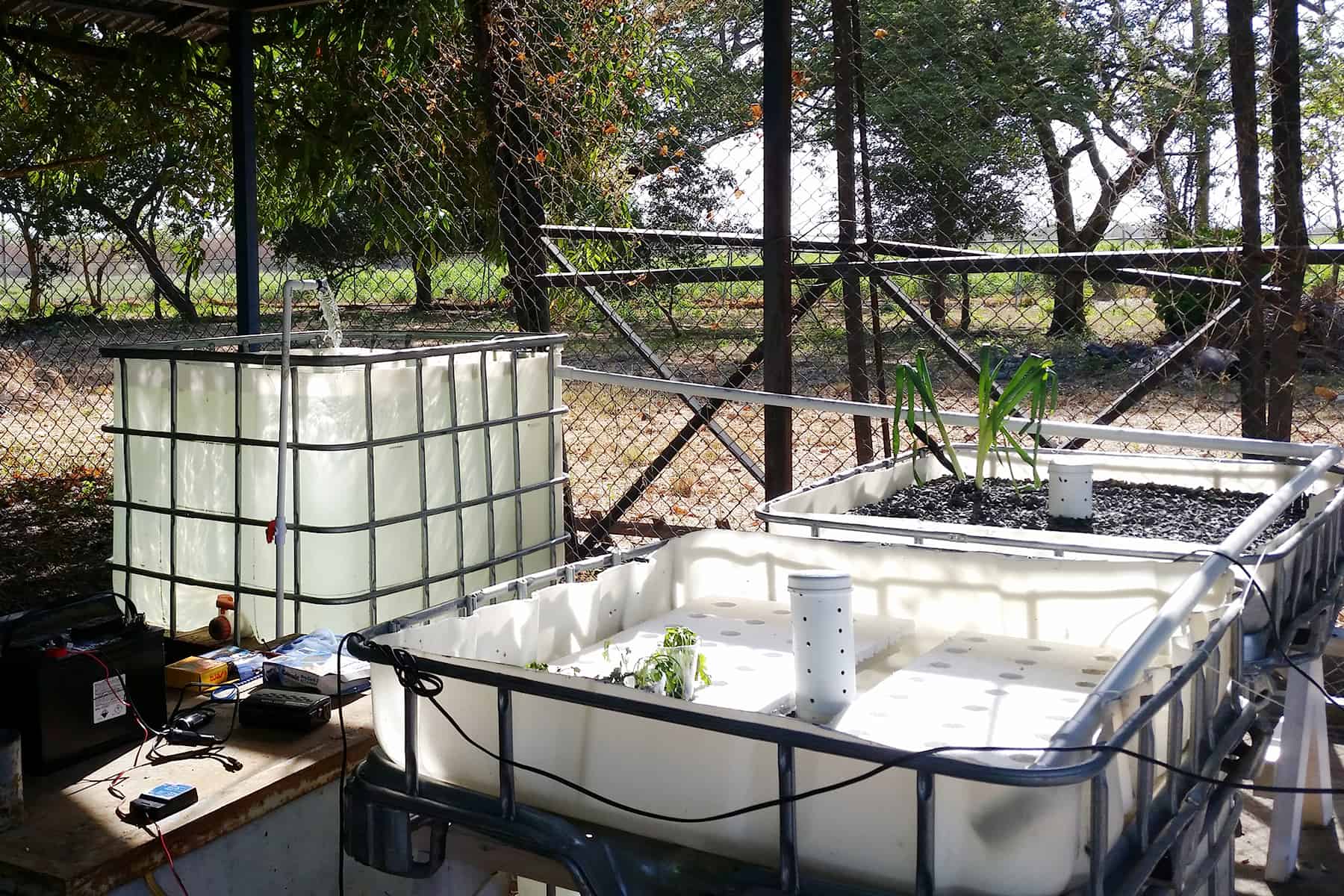
The Costa Rican government is launching a pilot aquaponics program in hopes of offering an alternative to farmers hit by drought. Agriculture and Livestock Ministry (MAG) officials are looking at possible implementation in the provinces of Guanacaste, Puntarenas and Alajuela, the most affected by severe drought conditions in recent years.
Aquaponics is a production method that combines aquaculture — raising aquatic animals such as fish, crayfish or prawns in tanks or ponds — with hydroponics — cultivating plants in water — in a symbiotic environment.
Water from the process is rich in minerals, especially ammonium widely found in fish waste, and it works as an effective fertilizer that reduces crops’ growing time by up to 50 percent.
The process also reduces water use by up to 90 percent, according to research from MAG’s National Animal Health Service (SENASA).
When done in ponds, the water can be used to irrigate large crop fields. Farm animals can drink it. And the fish can be sold as well as eaten by the farmers.
Last month SENASA’s experts installed the first aquaponics system at a public high school in Sardinal, Guanacaste in order to start evaluating the results.
The experimental module was built in Costa Rica, but program coordinator Luis Molina Carvajal said another nine systems will be imported from abroad and will be installed at high schools and other locations in those three provinces in the coming weeks.
SENASA experts say results from the first system show it is both sustainable and efficient. “The system at Sardinal contains 3 cubic meters of water, started with 10 tilapia and is now capable of producing 18 kilograms of forage a day,” Molina told The Tico Times.
Ministry officials have started informing farmer groups and chambers about the project, hoping they’ll be interested in promoting aquaponic projects among their members.
Leaders of Guanacaste’s Federation of Cattle Farmer Chambers have already expressed interest in the program and SENASA will install one of the modules at the group’s facilities in Liberia.
“We are also contacting other regional chambers and informing them about their options for obtaining loans and social assistance so that even small farmers can implement a module on their farms,” Molina said.
The project is also being proposed as a way to produce forage at farms in the higher elevation areas of Cartago province, where grass has been affected by ash from the Turrialba volcano since last year.
The exact cost of implementing an aquaponics system is one of the variables that ministry officials are trying to determine. So far they haven’t been able to find a local company able to supply the materials for a full system.
“Currently we are finishing negotiations with a company in Mexico that offers the manufacture, installation and required training for maintaining the remaining nine systems,” Molina said. The experimental modules will be installed over the next three weeks.
In addition to financing options, ministry officials are engaging in “persuasion efforts,” as Molina calls them. He said farmers can be reluctant to try new production techniques.
“Weather conditions in Costa Rica traditionally have been mostly favorable for agriculture,” Molina said. “So our farmers are, for example, not used to storing fodder and feed for various months as farmers must do in countries where snow covers fields for up to six months, or who must grow all of their crops in greenhouses, like in Israel or Saudi Arabia. Our farmers usually want simple solutions.”
Severe drought conditions in 2014 caused an approximately 75 percent reduction in pasture growth, Agriculture Minister Luis Felipe Arauz reported earlier this year.
The reduced feed affected production — mostly in Guanacaste, Puntarenas and Alajuela — with losses totaling some 5.8 million liters of milk, 2.5 million kilograms of meat and 2,400 kilograms of honey.
Costa Rica’s agricultural sector lost at least $25.6 million last year due to drought, according to government data.