

Recommended: The tiny fish that captures more carbon than the rain forest
The 1991 eruption of the Mount Pinatubo Volcano in the Philippines spewed 20 million metric tons of sulfur dioxide into the atmosphere, and scientists estimate it contributed to a global cooling of up to 0.04 degrees Celsius. But while large eruptions are widely recognized as climate coolers, the gas contributed by small eruptions was written off as insignificant.
But after 1998, warming began to slow and the atmosphere entered into what scientists call the “global warming hiatus.” The hiatus went against all previous climate change models, which predicted that temperatures would steadily increase through the early 2000s. Scientists knew they had missed something.
By using satellites, ground monitoring stations and suspended hot air balloons, researchers studied the suspended air particles in the lower parts of the atmosphere. The study found that between the years 2000 and 2013, volcanic gasses deflected nearly double the solar waves as previously estimated, cooling the Earth by as much as 0.12 degrees Celsius.
“This is part of the story about what has been driving climate change for the past 15 years,” Alan Robock, a climatologist at Rutgers University in New Jersey told the American Geophysical Union. “It’s the best analysis we’ve had of the effects of a lot of small volcanic eruptions on climate.”
Though relatively insignificant in terms of the size of eruptions, Costa Rica’s volcanoes likely contribute to this global cooling.
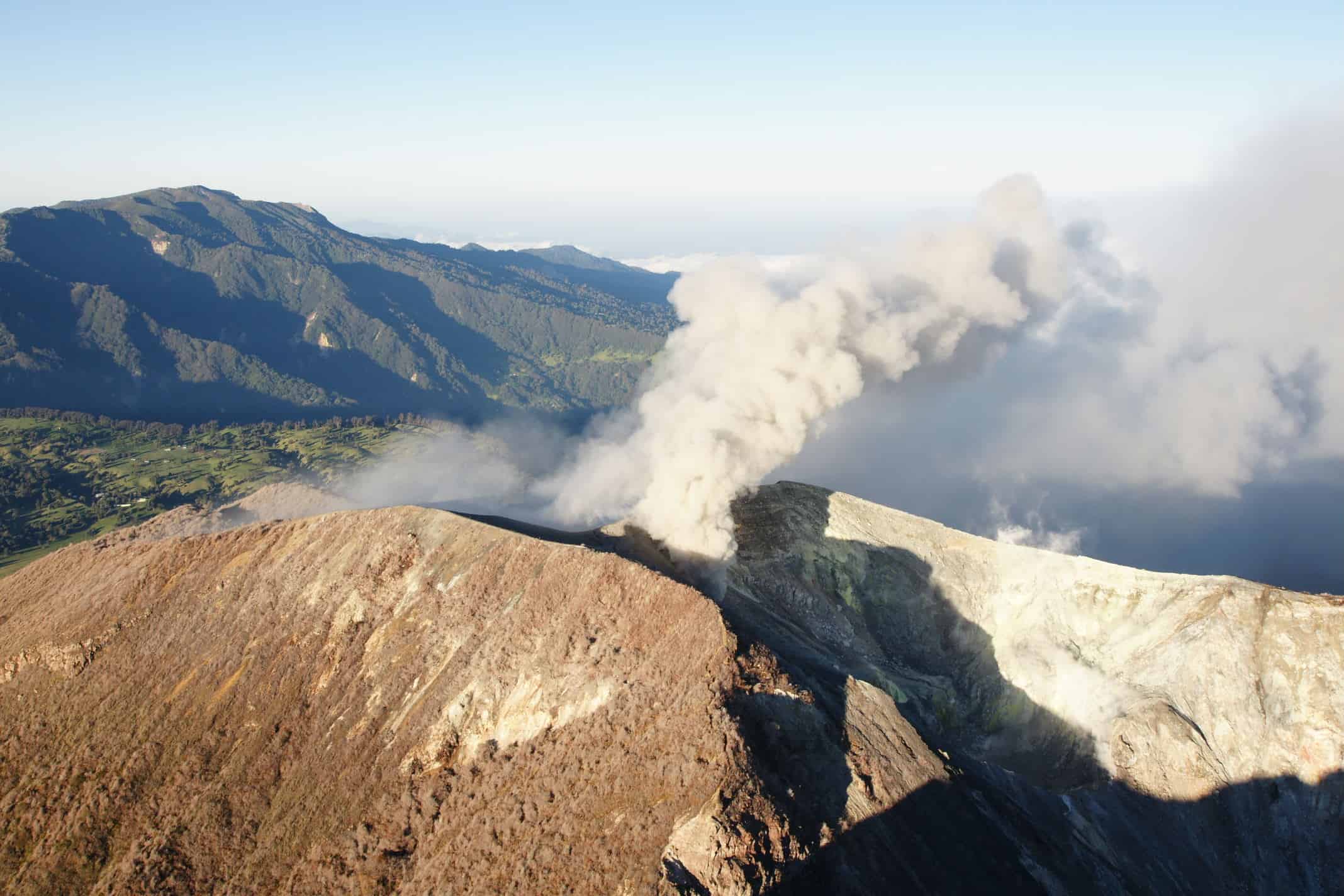
For years, Arenal Volcano in the country’s northeast spewed lava and gas on a daily basis, but in 2010 the eruptions abruptly paused. The country’s most active volcano is now Turrialba, some 60 kilometers northeast of the capital, which had its largest eruption in more than 150 years on Oct. 30, 2014.
According to María Martínez, a volcanologist with the Volcanological and Seismological Observatory of Costa Rica (OVSICORI), Turrialba spills between 400 and 1,000 metric tons of sulfur dioxide into the atmosphere each day. During the explosions between Oct. 20 and 31, the volcano spewed between 5,000 and 10,000 metric tons per day.
“Compared to other volcanoes throughout the world, our volcanoes don’t erupt often,” María Martínez told The Tico Times. “But they still release a pretty significant amount of gas. Turrialba is one of the most active volcanoes in the region.”
Recommended: Turrialba Volcano eruption in Costa Rica: Photos from the web





