

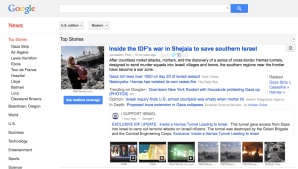
Spain was where the “right to be forgotten” began, with the European Commission recently ruling that individuals can demand that Google remove unfavorable links about them from search results. Now a new copyright law is stirring controversy in the country and is part of a bigger European debate about Internet rules.
Last week, Spain passed a law requiring news aggregators such as Google News to pay publishers a fee if they link to their content. Supporters of the law, nicknamed the “Google Fee,” say it will prevent copyright infringements. But opponents argue that it limits freedom of expression.
Aggregators that don’t compensate publishers for using their content could be fined 30,000 to 300,000 euros ($40,393 to $403,932). Spanish Web sites risk being blocked if they do not comply with the law, even if they are hosted in other countries.
In their blog, the local news aggregation site Menéame said that although they make money by linking to news stories published by others, it’s not enough to cover the fees required under the law. The publishers, meanwhile, make much more from their relationship, the site said. “Every unique visit derived from Menéame drives revenue for the linked news site that is almost 20 times more than the revenue perceived by Menéame,” they say.
It is unclear whether the law applies only to news aggretators like Google News, or whether social networks like Facebook and Twitter could also be affected. Spain’s culture, education and sports ministry said in a statement that social networks won’t be affected by this law, as it targets commercial companies like Google.
But lawyer and blogger Carlos Sanchez Almeyda argues that the law could affect social networks. The biggests in Spain are Facebook and Tuenti, where users spend an average of more than four hours a day, Comscore Spain reported, an hour more than the average U.S. user. Almeyda also said that blogs, forums and Wikipedia might also be charged for uploading or linking to copyrighted content.
Bloggers and social media fans protested online with the hashtags #EnlaceLibre (Free links) and #Todoscontraelcanon (Everybody against the fee). Many of them warned that this is may be “the end” of the free Internet and that social media may disappear in Spain if users are no longer allowed to share stories produced by somebody else.
Some reporters also joined the debate, arguing that media outlets won’t benefit from link removals as news sites are likely to see less traffic referred from aggregators. “The fact that an aggregator links to our stories, whether they are charged or not for doing so, always benefits us,” freelance journalist Carlos Otto said.
In its official blog, Google Spain said that publishers can choose not to appear on Google News. “In spite of this, it is worth mentioning that we received much more requests [from publishers] to be included in Google News instead of to be excluded, because many publishers can tell the advantage of having their content discovered by new readers or members of the audience.” The company also noted that Google News is ad-free.
Supporters of the Spanish law, including government and large publishers, say that the law only targets major corporations that make a profit from linking to content. Most of the revenue from online advertising goes to Google, rather than to publishers that create the content, they say.
“This [law] won’t affect the end user or the blogger, but big search engines that make a commercial use,” said the Association of Spain’s Newspapers (AEDE).
Without this law, aggregators could deprive citizens of “free, high-quality information online,” said José María Bergareche, president of AEDE, which brings together Spain’s largest publishers such as Planeta, Vocento, Grupo Prisa, Grupo Zeta and Unidad Editorial, among others.
Over the past few years, European countries, including France, Germany and Belgium, have also been debating copyright regulations, the Global Cybersecurity Web site reported, with varying results. In Germany, aggregators can link to news stories for free but must pay a fee for displaying significant amount of the content. In France, publishers last year reached an agreement with Google: The tech giant created a 60 million euro fund ($80 million) to help news companies expand their digital units. Belgium was more drastic: Google was forbidden to distribute written stories and photographs created by media companies.
In spite of the flurry of European debate about copyright rules, many Internet experts say Spain’s latest effort is isolated and that that the law’s effects are still hard to predict.
© 2014, The Washington Post





