


WASHINGTON, D.C. – China, a nation recognized by Costa Rica but diplomatically shunned by Central America’s six other countries, is dramatically raising its profile with President Xi Jinping’s recent visit to Brazil, Argentina, Venezuela and Cuba.
On Monday night, Xi arrived in Havana on the last leg of his marathon trip, following a visit to Caracas, where he established a $4 billion joint development fund with Venezuela, pledged to spend $691 million to explore Venezuela’s gold and copper reserves, and agreed to build a third Chinese-Venezuelan satellite.
He began the visit in Fortaleza, Brazil, on July 13, ahead of a summit that brought together the leaders of five of the world’s major emerging economies: Brazil, Russia, India, China and South Africa (BRICS).
The tour – Xi’s second to Latin America since taking office – is aimed partly at countering U.S. influence in the region, say analysts who discussed the visit in a July 11 briefing hosted by the Washington-based Wilson Center for International Scholars.
The briefing, “China’s Broadening Footprint in Latin America: From Beijing to Buenos Aires,” brought together five experts: Jorge Heine, Chile’s ambassador-designate to China, Adriana Abdenur of the BRICS Policy Center at Brazil’s Pontifical Catholic University in Rio de Janeiro, Richard Feinberg, former public policy scholar at the University of California-San Diego, Gonzalo Paz of George Washington University, and Robert Daly, director of the Kissinger Institute on China and the United States.
“Xi will use this trip to build up new multilateral fora like BRIC and CELAC [Community of Latin American and Caribbean States], and give China some of the diplomatic influence and space it seeks in a world it sees dominated by the United States,” Daly said.
“The U.S. is paying scant attention to this visit, which is worrisome to me. We take too much comfort from the narrative that as China spreads into Latin America and Southeast Asia, it’s experiencing a backlash – and is being criticized for neo-imperialist, extractive policies. They give most of the jobs to Chinese, and there has been a backlash,” he said. “But I see China learning rapidly and adjusting its policies, development and aid policies – and stealing the march in diplomatic terms.”
Last Thursday while in Brasília, Xi signed several deals with Brazilian President Dilma Rousseff, including a $3.2 billion agreement to buy 60 Brazilian-made Embraer E190 passenger planes. He also proposed a $20 billion fund to finance infrastructure projects throughout Latin America and the Caribbean.
In addition, Xi offered a $10 billion credit line to members of CELAC, as well as a $5 billion Chinese-Latin American cooperation fund for investments.
“Xi’s visit is extremely important,” said Heine. “It’s not just another routine visit, but it means a ratcheting up of the links between Latin America and China.”
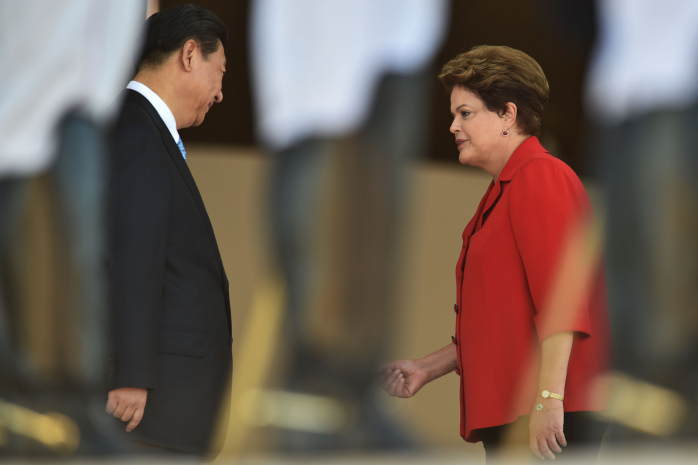
Last year, trade between just China and Brazil came to $83 billion, with 41 percent of all Brazilian exports ending up in China. Likewise, 34 percent of the country’s imports were of Chinese origin, according to government statistics.
Feinberg said Xi’s visit offers China an opportunity to show the region that it’s not just another neocolonial power hoping to sap Latin America of its natural resources.
“The trade between China and Latin America has not only boomed in the last decade, but has been of the traditional sort, with Latin America exporting raw materials and commodities, and Asia selling manufactured goods,” he noted.
“Many people have said this is not a good trend, and that it’s going back to the past, when the region was dependent on unstable commodity markets. But things are really different this time. Commodity prices have softened but have still remained high in historic terms. Also, Latin America is making better use of the foreign exchange that it’s earning from commodity exports, and the quality of governance in Latin America is higher. The region is now sitting on hundreds of billions in foreign-exchange reserves.”
In addition, said Feinberg, the commodities themselves are more diversified than ever, ranging from metals like iron ore and copper to agricultural goods such as soybeans, grains and beef.
“One might ask why hasn’t Latin America gone more protectionist when it’s been flooded by manufactured imports from Asia, particularly China, as it might have done in past decades,” he said. “The answer is that because many Latin American companies are successfully exporting to Asia, and that creates an export lobby. Governments are taxing this trade, so it’s an important contribution to fiscal policy. It helps consumers who are benefitting from this surge of inexpensive imports. So the winners have counterbalanced the losers, and protectionism has been avoided.”
Asked by The Tico Times what impact Xi’s trip might have on regional relations with Taiwan, Daly referred to another visit – that of Zhang Zhijun, chief of the mainland’s State Council Taiwan Affairs Office, to Taiwan in June. His four-day trip marked the first time since 1949 that a Taiwan affairs chief from mainland China set foot on the island, which the communist government in Beijing considers a renegade province of China.
“My flight from Beijing to Taipei took me less than three hours. But it took us 65 years to make that flight possible,” Zhang said at a meeting in Taoyuan with his counterpart, Wang Yu-chi, chief of Taiwan’s mainland affairs office.
“Particularly in light of this recent visit, relations have been getting friendlier,” Daly said. “It’s clear Beijing is playing the longer game and not seeking to punish nations that have relations with Taiwan. Beijing has moved quite aggressively and successfully with those nations, and the concerns which would have been there 20 years ago have diminished greatly.”
For example, he said, “Nicaragua does not have relations with Beijing. However, that does not prevent the Chinese from at least talking about and going ahead with constructing a $50 billion interoceanic canal.”
More importantly, said Daly, Xi is engaged in a big anti-corruption campaign back home, and at the same time wants to launch major economic reforms throughout the nation of 1.3 billion while becoming a leader in Latin America, “so images from this trip will help him project an image of a strong China to the Chinese people.”
Recommended: Even without diplomatic ties, Costa Rica still ranks as Taiwan’s top Central America trade partner





