
Despite having only 9 percent of the world’s population, Latin America and the Caribbean register more than 30 percent of the world’s homicides, according to a security expert at the World Bank.
Rodrigo Serrano-Berthet, the World Bank’s citizen security coordinator for Latin America and the Caribbean, made the statement on Wednesday, saying that economic improvements in the region have not translated into reduced crime.
“Other areas of concern to Latin Americans, such as inflation, poverty and unemployment, have improved,” Serrano-Berthet said in an interview posted by the World Bank. “By contrast, the incidence of crime and violence has not changed in recent decades, and remains at very high levels, much higher than in other regions.”
Serrano-Berthet said seven of the 10 highest homicide rates in the world were in Latin America, as well as 42 of the 50 most violent cities. Serrano-Berthet noted that the persistent problem in the region is not unsolvable. Most of the violence is concentrated in certain regions or certain demographic groups. For example, Serrano-Berthet said current worldwide homicide leader Honduras has 65 percent of its murders in only 5 percent of its cities. On demographics, Serrano-Berthet said focusing on at-risks groups such as young men and those of African descent in Brazil, for one instance, would help tackle the problem.
Story continues below.
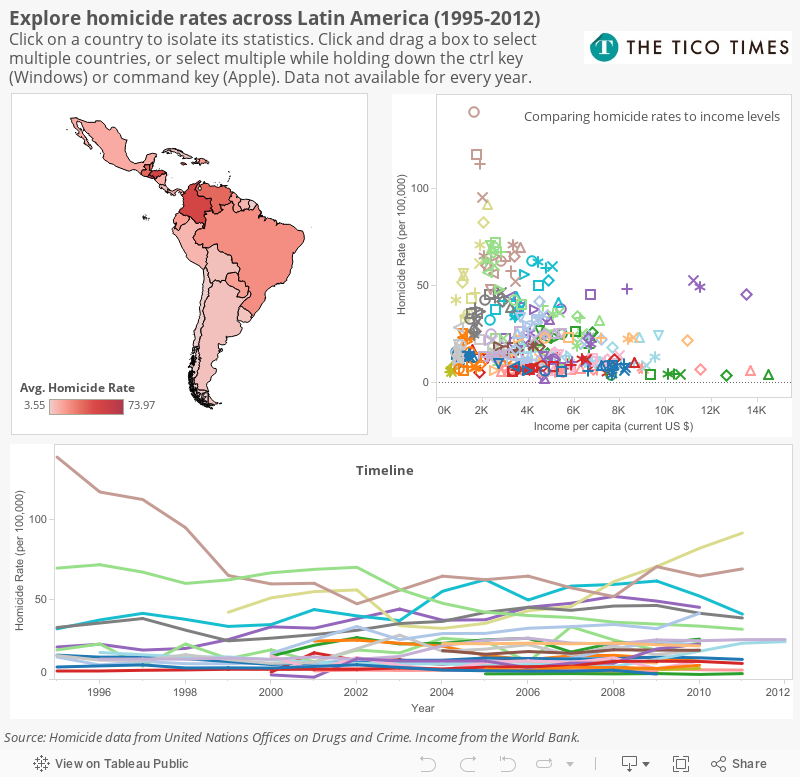
A Tico Times analysis of homicides and income levels showed no correlation between the two factors in the region. While many of the high income countries such as Chile and Uruguay also enjoy low homicide rates, others countries ranking in the top of the region on income such as Venezuela and Brazil maintained high levels of violence.
Brazil, the most populous country, is also the most striking example of Serrano-Berthet’s point about economic improvement failing to reduce crime. From 2004 to 2010, average incomes soared from $3,600 per person to almost $11,000 per person. However, homicides only dropped from 22.5 per 100,000 residents to 21.
On the other side, a number of low income countries reported very low homicide rates. Haiti, the poorest country in the region, with citizens making only $770 on average in 2012, reported an average of 5.8 homicides per 100,000 residents from 1995-2012. Nicaragua reported an average of 12.6 homicides per 100,000 residents during the same period, with a per capita income of $1,750 in 2012 – around half the income of some of the world’s leaders in violence, El Salvador and Guatemala.
Costa Rica had an average homicide rate of 7.6 per 100,000 residents during the period, with a significant increase since 2007. The country had a per capita income of nearly $9,400 in 2012. For comparison, the United States averaged a 4.7 homicide rate.

The Tico Times took a statistical correlation of the region, looking at every country’s income and homicide rate for every year available (1995-2012), finding a score near zero (-.002). Correlation scores vary between 1 and -1, with scores near 1 showing a strong correlation – meaning greater economic improvement translated to reduced murder rates. A score near -1 would show the opposite. A score near zero indicates no connection.
Serrano-Berthet was optimistic despite the problem’s entrenchment in the region.
“The United States has more than 30 years of experience with a wide range of violence prevention strategies. There is solid evidence that many of these work,” he said.
He cited government programs that visit mothers at risk of domestic violence as reducing their arrest rate by 82 percent in the U.S. He said Chicago’s “Becoming a Man” program that improves social skills of at-risk youth as reducing their violent crimes by 40 percent in one year.