
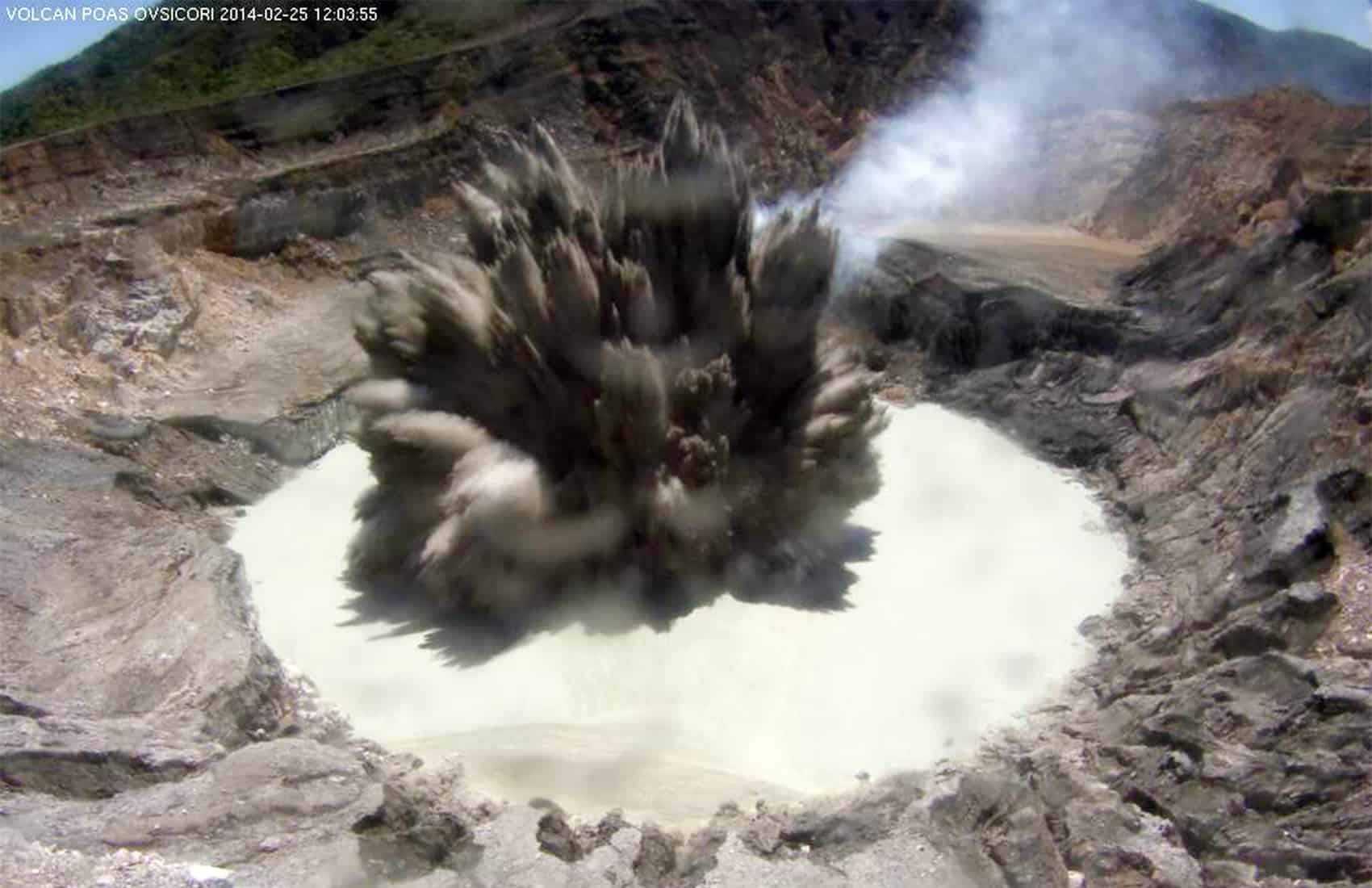
The crater of Poas Volcano expelled material 300 meters into the air at noon on Tuesday. The phenomenon, called a phreatic explosion, occurred due to a reaction between magma and water at the southern border of the lake inside the volcano. However, this was not an eruption and the volcano did not spew lava. Instead, a column of steam, gas and other materials formed and spouted out the top of the volcano, confirmed the Volcanological and Seismological Observatory of Costa Rica (OVSICORI).
BREAKING: Explosion at Poás Volcano captured at 12:03 p.m. with @OVSICORI_UNA's camera. pic.twitter.com/hYBbdlTbkh
— The Tico Times (@TheTicoTimes) February 25, 2014
María Martínez Cruz, a volcanology and geochemistry expert with OVSICORI, said the event can be considered “normal for the volcano’s activity, although explosion heights like the one recorded Tuesday are not that common.”
This type of explosion, called phreatic, occurs when the volcano’s magma contacts water in the crater’s lagoon and evaporates quickly through fissures. That action results in an blast of steam, water, ash and small rocks.
“[The volcano] has been calm for several months. It’s only releasing a lot of gas. This is part of the natural phenomenon, throwing tall columns of gas into the air, steam, the colors of the [volcanic] lake,” said Juan Dobles, administrator of the Poás Volcano National Park.
Currently there is no risk to visitors since most materials dissipate in the wind, Martínez added. Poás Volcano National Park is open from 8 a.m. to 3:30 p.m. every day, and visitors can walk to a lookout point to get a scenic view of the volcano. The Poás Volcano National Park is the second most visited in the country after Manuel Antonio National Park in the Pacific.
Martínez, who is part of an expert group currently monitoring the activity at Poás, added that they have been monitoring the volcano closely since an increase in the crater’s temperature was detected in recent years. The increase could be an indicator of volcanic activity.
Martínez explained that the average temperature of the Poás crater in the last 50 years has been 92 degrees Celsius (198 Fahrenheit), but in 2013 they recorded temperatures between 200-400 degrees Celsius (392-752 degrees Fahrenheit).
“Today’s explosion reached 720 degrees Celsius (1,328 ºF), which is the second highest after those recorded between June-September 2011 when we recorded temperatures up to 890 degrees Celsius (1,634 degrees Fahrenheit),” she said.
Poás also recorded activity in 2010 and in February last year, when other materials from phreatic explosions reached the visitors area.
See a sequence of pictures taken from OVSICORI’s webcam at Poás Volcano:

Tico Times reporter Zach Dyer contributed to this story.