

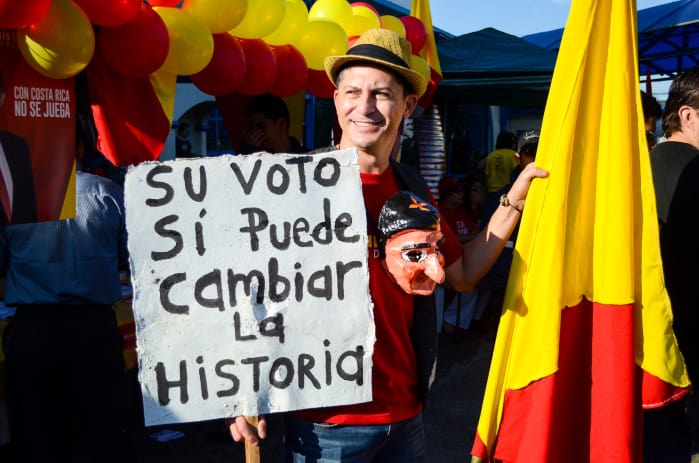
The results of Costa Rica’s Feb. 2 elections demonstrate the ability of the country’s political system to evolve with changing times.
The rise of the Citizen Action Party (PAC), whose candidate Luis Guillermo Solís won the popular vote with 31 percent, will make it the second “majority party,” along with the currently ruling National Liberation Party (PLN). PAC will usurp the role of the scandal-plagued and weakened Social Christian Unity Party (PUSC).
The demise of PUSC as a major force in national affairs was marked by the jailing of two of its former presidents, Miguel Ángel Rodríguez, accused of accepting bribes from the French telephone company Alcatel, and Rafael Ángel Calderón, convicted of defrauding Costa Rica’s Social Security system.
Rodríguez maintains his innocence, and during an appeal the statute of limitations on the charges in his case expired. Calderón’s case is under appeal.
The showing of the leftist Broad Front Party, which finished a strong third with more than 17 percent of the vote, secures the party’s place in the traditional role of the left in Costa Rica as a watchdog, keeping the two main parties to their promises of social justice.
In this way, the country has demonstrated its trademark historical coherence in its political evolution.
According to political scientist and former PUSC lawmaker Constantino Urcuyo, the elections highlight a new stage in Costa Rican history marked by an evolution that began with the country’s era of reform during World War II, which culminated with the country’s 1948 Civil War.
The reforms gave Costa Rica universal health and a labor code, while the Civil War gave rise to the PLN that broadened the reforms – most notably by nationalizing the banking system and creating the state telecommunications and energy monopoly, the Costa Rican Electricity Institute.
The war drove the Communist Party and populist President Rafael Ángel Calderón Guardia into exile. Both returned, however. Calderón Guardia headed coalitions that challenged the PLN for power until his son Rafael Ángel Calderón Fournier institutionalized the political force into a right-of-center PUSC in 1984. The Communist Party formed a third force that won one or two congressional seats per election and held the majority parties to their social-reform promises.
The year 1984 also marked a shift in the balance of power in Costa Rica, where the main political parties began to lose their left-wing/right-wing identities and signed on to a political project that saw the whittling away of the country’s state welfare institutions.
Under the strain of an unprecedented economic crisis, the country’s powerful business sector united in the Union of Private-Sector Chambers and Associations (UCCAEP), which played a key role in driving the political party in power to accept the terms of International Monetary Fund structural adjustment programs.
Solís met with the chamber on Thursday to reassure its members that he has no radical departure in economic policy in mind for Costa Rica.
Under this process, the party in power privatized one element of the welfare state and paid the price at the polls in the subsequent election, which ushered in the other main party that would then repeat the process until it became apparent to Costa Rican voters the two main parties differed little in their inability to defend all the social conquests of the social-reform era.
The governments did, however, achieve a major restructuring of the country’s economy, diversifying it to the point where the traditional products – coffee and bananas – are now less important to the economic mix that now features high tech and tourism as the main source of national income.
Nonetheless, the similarities of the two main political parties led many in Costa Rica to identify the country’s driving political force not as PLN or PUSC but as “PLUSC.”
The departure of the political parties from their traditional social-reform roots eventually caused politics in Costa Rica to fragment. Traditional social democrats like PAC founder Ottón Solís split from the PLN, while left-leaning populist supporters of the main parties migrated to the Broad Front Party. Right-leaning former PUSC members joined Otto Guevera’s Libertarian Movement Party.
With the economic reform of the country virtually complete, Costa Rica’s politics now revolve around issues of governability, including citizen security and curing government corruption.
But the geometry of the political forces at play has a distinctly traditional look, as the winners of the 1948 Civil War – the PLN – continue to hold a place as an institutional political power. PAC has taken the place of the PUSC as a countervailing force capable of forcing the PLN from power.
Few issues remain to iron out in the country’s economic reform, though Luis Guillermo Solís agreed to disagree with the private sector titans of UCCAEP over the privatization of electricity to complete ICE reform.
On other issues, Luis Guillermo Solís has signaled that he will not depart radically from current economic schemes, though he has sent strong signals that corruption will not be tolerated under his rule. He also said he would stay the course in other ways such as maintaining joint drug patrols with the U.S. Coast Guard.
If Solís is able to win the presidency from Araya in April’s runoff, a new era will dawn for Costa Rica that sees an end to the rule of traditional parties in the country, but also the continuation of a stable dynamic that has seen the country through rough waters in one of the most volatile regions on the planet.
Formerly a reporter and assistant editor at The Tico Times, John McPhaul is a freelance writer who lives in San Juan, Puerto Rico.





