

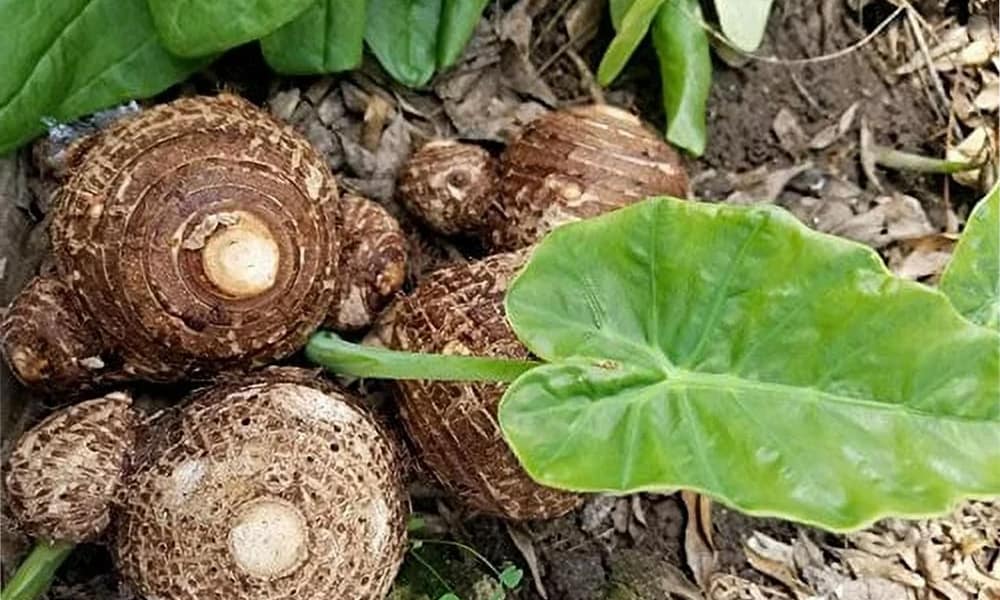
Unless you live in the high mountainous regions of the country, growing potatoes in the home garden is practically impossible. We’ve tried it, and usually end up with a harvest of potatoes the size of marbles. But don’t dismay. There’s a solution to the dilemma: you can grow taro roots, which provide an excellent substitute for potatoes, particularly when it comes to making mashed potatoes – I mean, mashed taro roots.
Taro or coco yam (Colocasia esculenta) is a member of the elephant ear family, Aracea. In Costa Rica it is known by the indigenous names ñampi, tiquisqui and malanga.
Taro was originally native to Malaysia, where it spread throughout the continent as a staple for China, India and the Polynesian Islands of the Pacific. Hawaiians are famous for skillfully cultivating taro, which they call kalo. Poi is the name of their favorite fermented taro-root dish.
Most likely, the Spanish introduced taro to Mesoamerica from the Philippines, or the English did with slave trading from Africa. It didn’t take long before the indigenous tribes of our region adopted the plant into their agricultural practices and diet, and for good reason: taro root is a nutritious food crop.
In comparison with potato, taro corm has a higher proportion of protein (1.5-3%), calcium and phosphorus; it has a trace of fat, and is rich in vitamins A and C. Moreover, taro is 98.8% digestible, because it has very small starch grains fairly rich in amylose (20-25%), which breaks down to sugar with human saliva. This type of carbohydrate is excellent for people with digestive problems.
For over 100 million people in the world today, taro is an important daily food.
Taro is propagated vegetatively by planting smaller auxiliary corms or by removing the upper half-inch of the corm with new shoots. In Costa Rica, farmers traditionally plant taro in the later weeks of March. We have found over the years that taro can be grown well in drier soils enriched with aged compost and mulched. We add at least one good shovel full of compost for each new corm we plant.
Plant the corms 50 centimeters apart in rows a meter apart. The plants can be cultivated occasionally to eliminate weeds and build up the soil around each plant, which stimulates the production of new roots.
The new crop is usually ready nine months after planting, and you can harvest for many months. During the dry season, pull up all the plants and save the smallest corms for next year’s planting. It’s best to rotate taro plantings to avoid insect problems and plant disease. The larger corms can be washed, dried and stored in a shady area for many months. Taro roots are peeled, just like potatoes, although the peel of taro is hairy.
Costa Ricans traditionally cook taro with vegetables and meat for hours to make a stew called olla de carne. Another way of preparing taro is in puree. I like to cut the taro in small bite-size pieces to steam or boil for 30 minutes. It’s important that taro roots be cooked well. Heating is necessary to remove the acrid, irritating crystals of calcium oxalate of the raw corm, which causes irritation to the mucous membranes of the mouth and throat. Check cooked taro with a fork to insure it is soft and done, then blend with some of the cooking water or milk until you have a rich puree.
During pejibaye (peach palm) season, you can blend cooked and peeled pejibayes with taro to make a colorful soup, delicious topped with fresh, diced chives from the garden.
Taro corms are also roasted or baked, and may be made into cakes with left over mashed taro. Add one egg, along with onions, grated carrots and parsley, to your taro puree, shape into cakes and heat in a frying pan. They are delicious with curry seasoning, too.
As you can see, taro can be a wonderful substitute for potatoes in the tropics, and you can simply select healthy corms from the local market to plant in your home garden.





